 Skip to content
If you have ever tried to lose weight without knowing how many calories your body actually burns in a day, you already know how frustrating it can feel. You cut back on food, you exercise, yet the scale barely moves. This is usually because you are guessing your calorie needs instead of calculating them. A TDEE calculator for weight loss removes that guesswork and gives you a real, personalized number to work with.
TDEE stands for Total Daily Energy Expenditure. It is the total number of calories your body uses every single day, including the calories burned while resting, digesting food, moving around, and exercising. Once you know your TDEE, losing weight becomes a matter of simple math rather than trial and error.
What Is TDEE and Why It Matters for Weight Loss
Your body needs a certain amount of energy just to stay alive. This baseline is called your basal metabolic rate, often shortened to BMR. On top of that, your body burns extra calories through digestion, daily movement, and workouts. When you add all of these together, you get your TDEE.
Knowing your TDEE matters because weight loss ultimately comes down to energy balance. If you eat fewer calories than your TDEE, your body pulls the difference from stored fat, and you lose weight. If you eat more than your TDEE, you gain weight. A TDEE calculator takes the mystery out of this process and gives you a starting point that is based on your actual body, not a generic diet chart.
How a TDEE Calculator Works
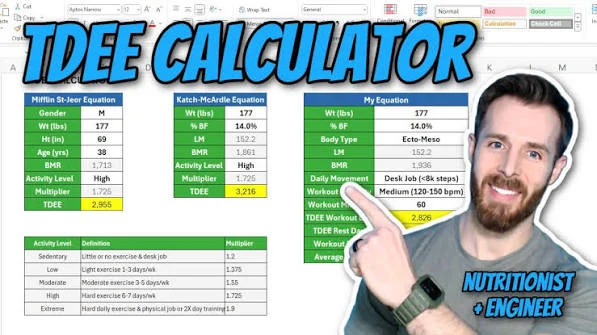
Most calculators use a two step process. First, they estimate your BMR using an equation such as the Mifflin St Jeor formula, which is considered one of the most accurate for the general population. Some tools also offer the Katch McArdle formula, which factors in your body fat percentage and works especially well for people who are lean or carry more muscle.
Once your BMR is calculated, the tool multiplies it by an activity factor based on how active your lifestyle is. This factor ranges from sedentary, meaning little to no exercise, all the way up to extremely active, meaning intense daily training or a physically demanding job. The result of this calculation is your maintenance calories, which is another way of saying your TDEE.
To turn this into a weight loss target, you simply subtract a calorie deficit from your TDEE. A moderate deficit of around 300 to 500 calories per day is generally considered safe and sustainable, and it typically leads to a steady weight loss of about half a kilogram to one kilogram per week, or roughly one to two pounds.
Inputs You Need for an Accurate Result
To get a reliable TDEE reading, you will usually be asked to enter your age, biological sex, current weight, height, and activity level. Some calculators also ask for your body fat percentage, which improves accuracy since muscle burns more energy than fat, even while resting. If you are unsure of your exact activity level, it is better to choose the lower option, since most people overestimate how active they really are.
Turning Your TDEE Into a Weight Loss Plan
Once you have your number, the next step is building a daily calorie budget around it. Many people also like to pair their calorie target with a macro calculator to balance protein, carbohydrates, and fats, since protein especially helps protect muscle mass during a calorie deficit. A body recomposition calculator can be useful too if your goal is losing fat while keeping or building lean muscle rather than just watching the scale go down.
It is worth remembering that a TDEE calculator gives you an estimate, not an exact science. Individual metabolism, sleep quality, stress, and hormone levels can all shift your real number slightly. The smartest approach is to use the calculator as your starting point, track your weight consistently for two to three weeks, and then adjust your intake up or down depending on the results you see.
Common Mistakes People Make
One of the biggest mistakes is cutting calories too aggressively in hopes of faster results. Dropping too far below your TDEE can slow your metabolism, cause muscle loss, and make the process harder to sustain long term. Another common error is forgetting to recalculate. As you lose weight, your TDEE naturally decreases, so a number that worked for you two months ago may no longer be accurate today. Recalculating every time you lose a noticeable amount of weight, roughly every four to six kilograms, keeps your plan aligned with your changing body.
Final Thoughts
A TDEE calculator for weight loss is one of the simplest and most effective tools you can use to take control of your progress. Instead of following restrictive diets or copying someone else’s meal plan, you get a number built specifically around your body and lifestyle. Combine that number with a sensible calorie deficit, enough protein, regular movement, and patience, and you give yourself a realistic path toward lasting weight loss rather than a quick fix that disappears the moment you stop following it.