Protein Calculator
How much protein do you need a day? Get a range in grams for your goal (general health, fat loss, muscle gain, endurance or age 65+) and how to split it across meals.
Key facts
- The official minimum for adults is 0.8 g of protein per kg of body weight a day.
- People who train, or who are losing weight and want to keep muscle, do better with about 1.6 to 2.2 g per kg.
- Spread it over 3 to 4 meals of about 20 to 40 g each.
Protein needs by goal
| Goal | g per kg a day | 70 kg person |
|---|---|---|
| General health | 0.8 to 1.0 | 56 to 70 g |
| Endurance sports | 1.2 to 1.6 | 84 to 112 g |
| Age 65 and over | 1.0 to 1.2 | 70 to 84 g |
| Building muscle | 1.6 to 2.2 | 112 to 154 g |
| Losing fat, with strength training | 1.6 to 2.2 | 112 to 154 g |
If your BMI is 30 or more, the calculator uses the weight that would give you a BMI of 25 at your height. Protein needs follow lean mass more than total weight, so this avoids a number that is far too high.
Protein in everyday foods
| Food | Amount | Protein |
|---|---|---|
| Chicken breast, cooked | 100 g | 31 g |
| Fish, cooked | 100 g | 20 to 25 g |
| Paneer | 100 g | 18 g |
| Tofu, firm | 100 g | 15 to 17 g |
| Chickpeas or lentils, cooked | 1 cup (about 165 to 200 g) | 15 to 18 g |
| Daal | 1 bowl | about 12 g |
| Greek yoghurt, plain | 100 g | 10 g |
| Milk | 1 cup (250 ml) | 8 g |
| Egg | 1 large | 6 g |
| Peanuts | 30 g (a handful) | 7 g |
Typical values; brands and recipes vary.
Tips for getting enough
- Build each meal around a protein food: eggs or yoghurt at breakfast, chicken, fish, paneer, tofu or daal at lunch and dinner.
- Combine plant proteins, such as daal with rice or roti or hummus with bread, for a fuller set of amino acids.
- A protein shake is convenient but not required; food works just as well.
- Older adults benefit from protein at every meal, together with strength exercise, to slow muscle loss.
Kidney disease? Don’t raise your protein intake without talking to your doctor first. The same goes for pregnancy and breastfeeding, when needs are different.
Hit your protein goal every day
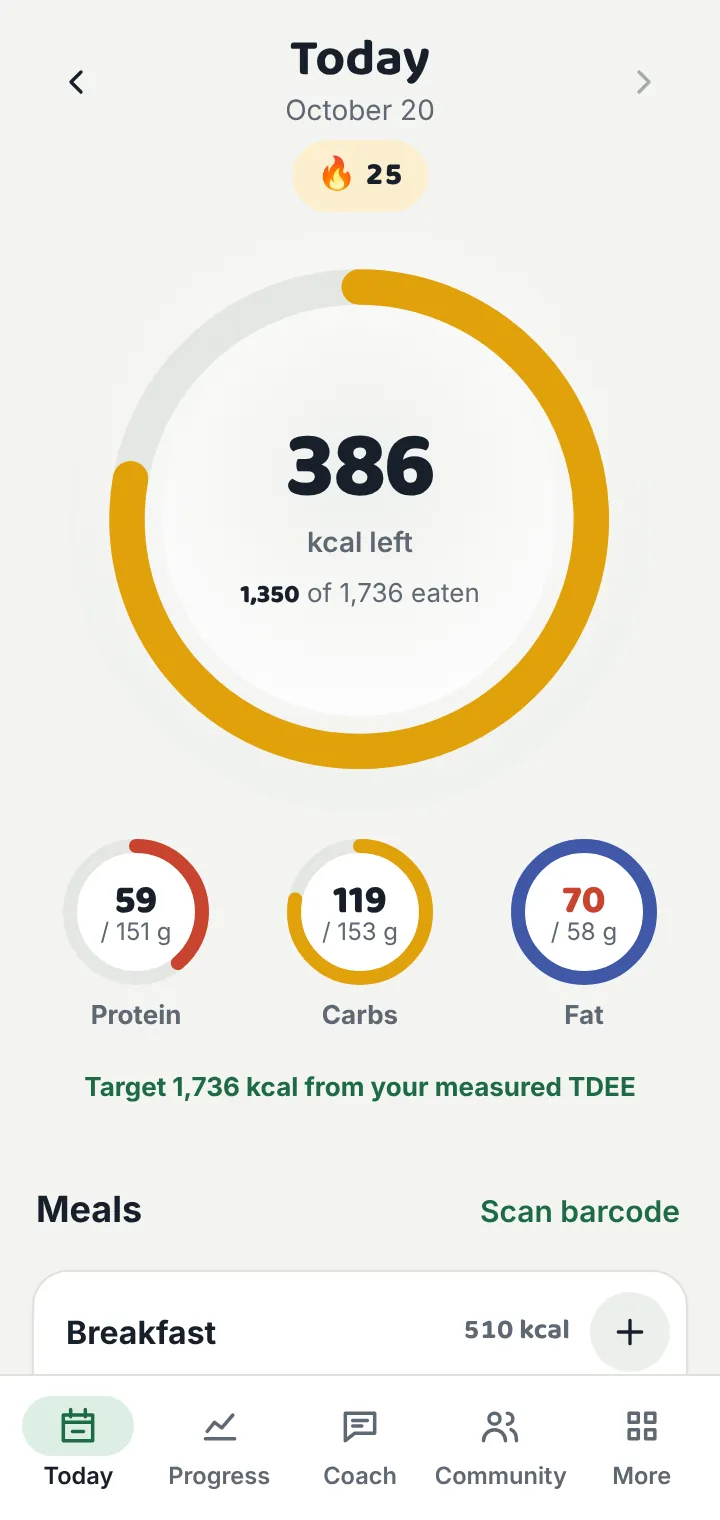
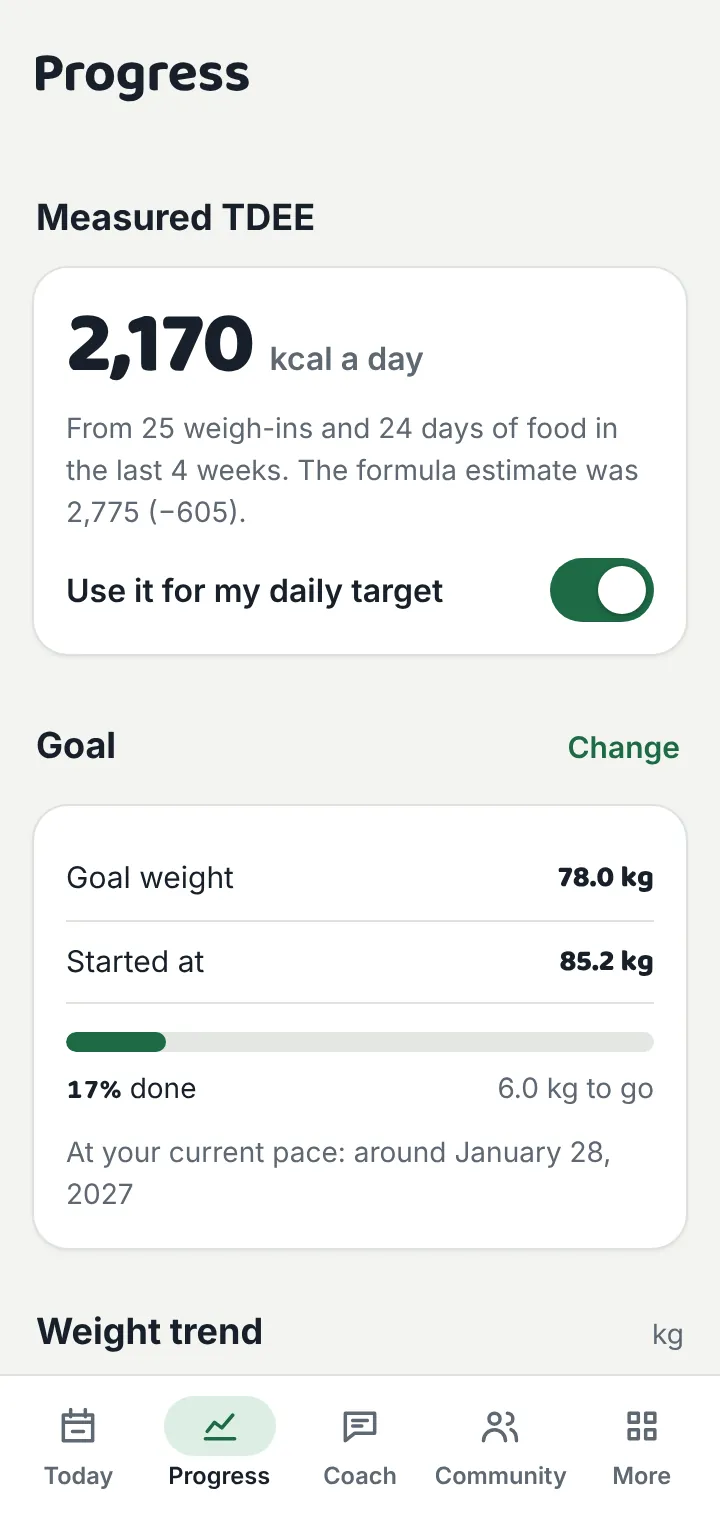
Calculators give an estimate. Log your weight and food for two weeks and the TDEE Calculator app works out what your body really burns, then keeps your target up to date.
- Measured TDEE from your own weight trend and food log
- Food diary with 356 everyday foods from around the world and a barcode scanner
- AI coach and photo calories: snap your plate, check the estimate, add it
- 74 languages, metric or US units, Ramadan mode and reminders
- Private: your log stays on your phone. No ads, no trackers
Protein calculator questions
How much protein do I need to build muscle?
About 1.6 g per kg of body weight a day captures most of the benefit for muscle growth with strength training; up to 2.2 g per kg may help some people, especially when dieting.
Can I eat too much protein?
For healthy people, intakes up to about 2 g per kg a day are considered safe. If you have kidney disease, follow your doctor’s advice.
How much protein can my body use in one meal?
Your body digests and uses all of it, but for building muscle, about 0.3 to 0.4 g per kg per meal (20 to 40 g) spread over the day works well.
Do I need protein powder?
No. It is just a convenient food. Eggs, dairy, meat, fish, pulses, tofu and paneer all count the same.
Why does the calculator give a range?
Research shows a range of intakes works for each goal. The middle of the range is a sensible daily target; eat towards the top when dieting hard.
Sources
- Institute of Medicine. Dietary Reference Intakes for Energy, Carbohydrate, Fiber, Fat, Fatty Acids, Cholesterol, Protein, and Amino Acids. National Academies Press; 2005. nap.nationalacademies.org/10490
- Morton RW, Murphy KT, McKellar SR, et al. A systematic review, meta-analysis and meta-regression of the effect of protein supplementation on resistance training-induced gains in muscle mass and strength in healthy adults. Br J Sports Med. 2018;52(6):376-384. doi.org/10.1136/bjsports-2017-097608
- Jäger R, Kerksick CM, Campbell BI, et al. International Society of Sports Nutrition position stand: protein and exercise. J Int Soc Sports Nutr. 2017;14:20. doi.org/10.1186/s12970-017-0177-8
- Bauer J, Biolo G, Cederholm T, et al. Evidence-based recommendations for optimal dietary protein intake in older people: a position paper from the PROT-AGE Study Group. J Am Med Dir Assoc. 2013;14(8):542-559. doi.org/10.1016/j.jamda.2013.05.021
- Thomas DT, Erdman KA, Burke LM. American College of Sports Medicine joint position statement: nutrition and athletic performance. Med Sci Sports Exerc. 2016;48(3):543-568.