Cutting Calorie Calculator
A cut is a planned stretch of eating below maintenance to lose fat while keeping the muscle you’ve built. Pick how fast you want to go and get your daily calories, protein and macros, your expected weekly loss and how long the cut will take.
Key facts
- Most people who lift do well on a deficit of 10 to 25% below maintenance, which usually means losing about 0.5 to 1% of body weight a week.
- Protein of 1.6 to 2.2 g per kg of body weight a day, plus continued strength training, is what protects muscle in a deficit.
- The leaner you already are, the slower you should cut. Faster cuts suit people with more fat to lose.
- Plan blocks of 8 to 16 weeks, then spend at least a couple of weeks at maintenance.
On this page
How the calculator sets your calories
It estimates your maintenance calories (TDEE) first. That uses Mifflin-St Jeor by default, or Katch-McArdle if you enter your body fat, because lean-mass formulas tend to fit lean, muscular people better. Then it takes 10, 20 or 25% off.
Why a percentage and not the classic “500 calories a day”? Because 500 kcal means very different things to different people. For a woman who maintains on 1,800 kcal it is a 28% cut. For a large man who maintains on 3,200 kcal it is about 16%. A percentage scales with your size, so the effort feels similar for everyone.
The calculator then estimates your weekly loss with the rough rule of 7,700 kcal per kilo (3,500 per pound), shows that loss as a share of your body weight, sets protein from your weight and splits the rest of your calories into carbs and fat. It starts on the high-protein split; you can switch to balanced, low-carb or keto in the results.
Choose your speed
| Speed | Deficit | Typical loss a week | Suits |
|---|---|---|---|
| Gentle | −10% | About 0.25 to 0.4% of body weight | People who are already lean, or who want to keep training performance high |
| Steady | −20% | About 0.5 to 0.7% | Most people who lift. A good default |
| Fast | −25% | About 0.7 to 0.9% | More fat to lose, a firm deadline and a well-planned diet |
Research on trained people points the same way. In a study of 24 elite athletes, those who lost about 0.7% of their body weight a week gained lean mass and strength over the diet, while those losing about 1.4% a week only held on to the lean mass they had. Evidence-based guidelines for natural bodybuilders recommend about 0.5 to 1% of body weight a week for the same reason: slower loss gives your training a better chance of keeping up.
Speed also has a hunger cost. A bigger deficit feels harder every day, and most diets fail on adherence, not on maths. If you have tried fast cuts before and rebounded, start with steady and let consistency do the work.
The calculator warns you if a target falls below about 1,200 kcal (women) or 1,500 kcal (men) a day, a common floor without medical supervision, or if you would lose more than 1% of your weight a week.
Protein on a cut
Protein does two jobs in a deficit. It gives your muscles what they need to repair and hold on after training, and it keeps you fuller than the same calories of carbs or fat.
A 2018 meta-analysis of 49 trials found that the extra muscle from eating more protein while lifting levelled off at about 1.6 g per kg of body weight a day, with some people still benefiting up to about 2.2 g. In a deficit, needs probably sit at the higher end. In one four-week trial, young men eating 40% below their needs while training hard six days a week gained about 1.2 kg of lean mass on 2.4 g/kg of protein. The group on 1.2 g/kg gained almost none, and also lost less fat.
In practice:
- Aim for 1.6 to 2.2 g per kg of body weight a day. If you have a lot of fat to lose, the calculator bases this on a healthier weight for your height so the target doesn’t come out unrealistically high.
- Spread it over three to five meals of roughly 0.4 to 0.55 g per kg each, which is about 30 to 45 g for an 80 kg (176 lb) person.
- About 30 g of protein looks like 100 g of cooked chicken breast, a drained 145 g tin of tuna, 300 g of plain Greek yoghurt, 150 g of paneer or a scoop of whey in milk.
The protein calculator gives your exact range and a per-meal split.
Keep training hard
Lifting is the signal that tells your body your muscle is still needed. Keep your main heavy lifts in the plan and try to hold your strength. If recovery suffers late in a cut, trim a few sets rather than switching to light “toning” weights, which removes the signal you are trying to send.
Cardio is a tool, not a requirement. Walking burns extra calories with very little fatigue. Hard cardio on top of heavy leg training can eat into recovery, so add it gradually if you add it at all.
Watch your steps, too. When people eat less they often move less without noticing: fewer trips up the stairs, more sitting. Losing 3,000 steps a day can quietly cancel around 80 to 120 kcal of your deficit. A step target keeps that leak closed.
How long to cut
Plan in blocks rather than open-ended dieting. These are coaching rules of thumb, not lab-tested limits:
| Starting point | A sensible first block |
|---|---|
| Plenty to lose (men above ~25% body fat, women above ~35%) | 12 to 20 weeks at steady or fast, with a week or two at maintenance along the way |
| Some to lose (men ~15 to 25%, women ~25 to 35%) | 8 to 16 weeks at steady |
| Already lean (men under ~15%, women under ~25%) | 4 to 10 weeks at gentle or steady |
Breaks can help. In the 2018 MATADOR trial, men with obesity did 16 weeks of dieting either in one go or in two-week blocks separated by two weeks at maintenance. The group with breaks lost more weight and more fat, and kept more of it off six months later. You don’t have to diet that way, but a week or two at maintenance every 8 to 12 weeks is a sensible pressure valve for hunger, training and mood.
Track the cut properly
- Weigh most mornings under the same conditions and compare weekly averages, never single days.
- Expect a fast first week. Less food and fewer carbs mean less water and gut content. The real pace shows from week two or three.
- Measure your waist every two weeks at the navel. If your weight stalls but your waist keeps shrinking, you are still losing fat.
- Log your main lifts. Stable strength late in a cut is a good sign you are keeping muscle.
- Recalculate after every 4 to 5 kg (10 lb), because a lighter body needs less food.
When the scale stops moving
One flat week is noise. Two to three weeks with no change in your weekly average means something has shifted: you weigh less now, you may be moving less, or portions have crept up. Work through it in this order:
- Log every bite for a week, weighing food where you can. Oils, drinks and weekend meals are the usual leaks.
- Check your daily steps against the start of the cut.
- If both look right, take 100 to 150 kcal a day off or add about 2,000 steps, then give it two more weeks.
Our weight loss plateau guide goes through every cause in more detail.
When to stop
End the cut and move to maintenance if you reach your goal, or if any of these show up:
- Your strength drops for two to three weeks in a row.
- Sleep, mood, focus or hunger become hard to manage.
- Your period becomes irregular or stops.
- You feel dizzy, cold all the time or unwell.
A missed or stopped period while dieting is a sign of low energy availability, which sports doctors call relative energy deficiency in sport (REDs). It affects bones, hormones and performance, so see a doctor rather than pushing on. The calculators on this site are for healthy adults; if you have a medical condition or a history of disordered eating, plan any cut with a professional.
Track your cut with your real numbers
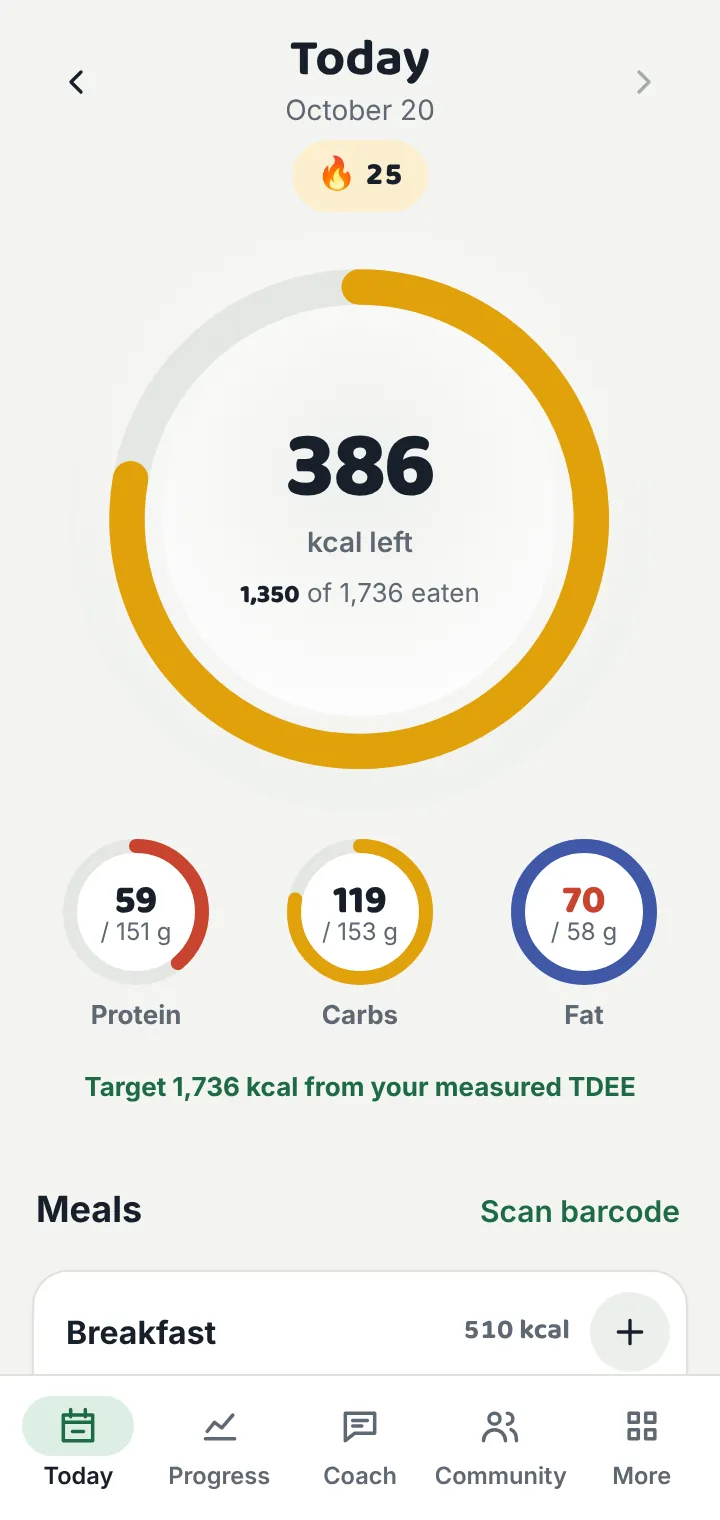
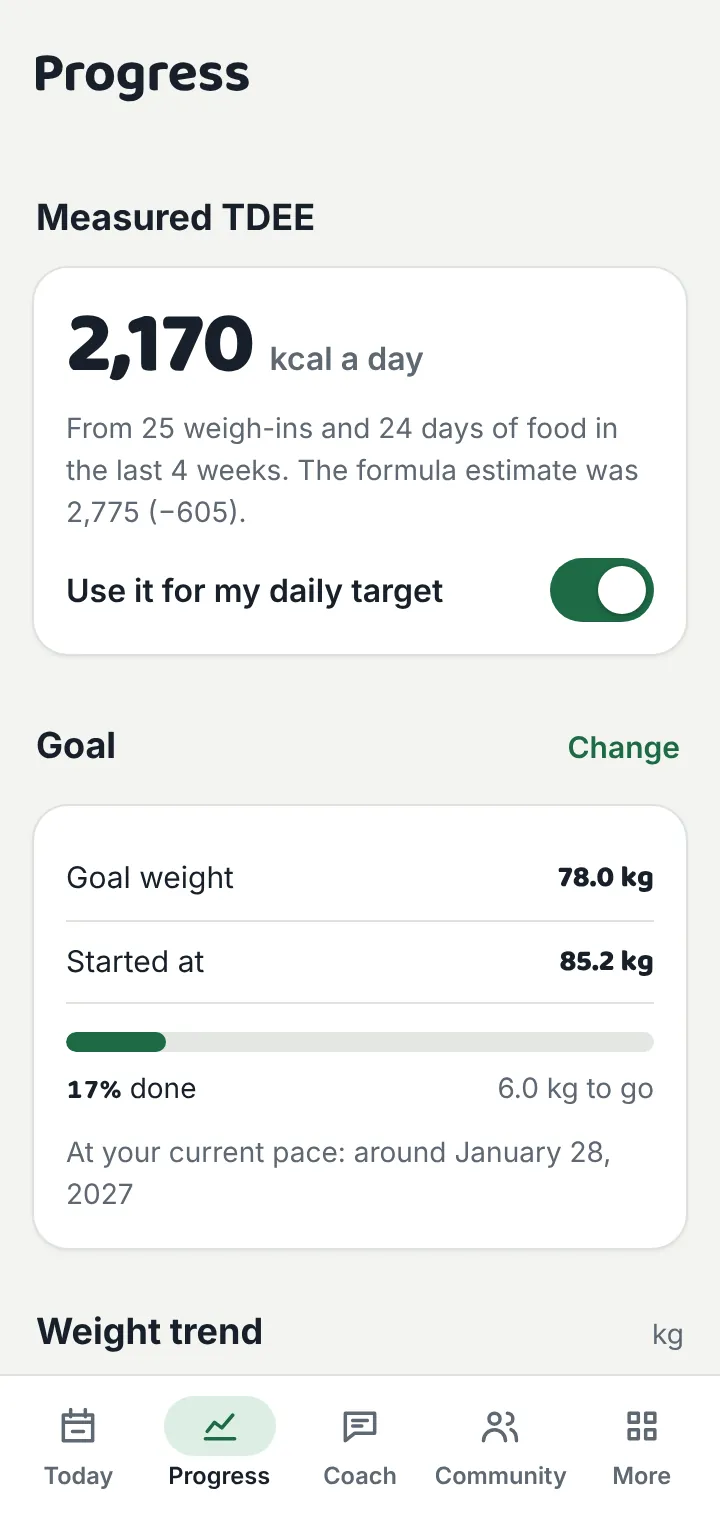
Calculators give an estimate. Log your weight and food for two weeks and the TDEE Calculator app works out what your body really burns, then keeps your target up to date.
- Measured TDEE from your own weight trend and food log
- Food diary with 356 everyday foods from around the world and a barcode scanner
- AI coach and photo calories: snap your plate, check the estimate, add it
- 74 languages, metric or US units, Ramadan mode and reminders
- Private: your log stays on your phone. No ads, no trackers
Cutting calorie calculator questions
How many calories should I eat when cutting?
Usually 10 to 25% below your maintenance calories. A 20% deficit suits most people who lift, which for someone who maintains on 2,500 kcal is about 2,000 kcal a day. Leaner people do better with a smaller deficit; people with more fat to lose can go a little faster.
Is a 25% deficit too much?
Not for everyone. It works for many people with a fair amount of fat to lose, for a limited time. It is usually too much if you are already lean, if it takes you below about 1,200 kcal (women) or 1,500 kcal (men) a day, or if you are losing more than 1% of your body weight a week.
Do I need cardio to cut?
No. The deficit does the work. Walking is an easy way to burn more without hurting recovery, and some cardio is good for your heart, but you can cut successfully with diet, strength training and a daily step target.
How much protein should I eat on a cut?
About 1.6 to 2.2 g per kg of body weight a day, spread over three to five meals. Lean, well-trained people in a large deficit may benefit from going a little higher, up to about 2.4 g/kg.
Why am I not losing weight in a deficit?
In the first two weeks, water often hides fat loss. After that, the usual causes are underestimated portions, fewer daily steps, or a maintenance figure that was too high to start with. Weigh daily, compare weekly averages and give any change two to three weeks before you adjust.
Should I eat back my exercise calories on a cut?
No. Your activity level already includes your usual training. Adding a watch’s exercise calories on top counts them twice and often wipes out the deficit.
How is this different from the calorie deficit calculator?
The calorie deficit calculator starts from a goal weight and a pace and tells you the date you could get there. This cutting calculator starts from a deficit size, focuses on keeping muscle, and gives you protein and macros for the cut.
Can women use the same cutting percentages?
Yes. The percentages work the same way. Women often have a lower maintenance, so check that the target stays above about 1,200 kcal a day, and compare weigh-ins at the same point in your cycle where you can.
Sources
- Helms ER, Aragon AA, Fitschen PJ. Evidence-based recommendations for natural bodybuilding contest preparation: nutrition and supplementation. J Int Soc Sports Nutr. 2014;11:20. doi.org/10.1186/1550-2783-11-20
- Garthe I, Raastad T, Refsnes PE, Koivisto A, Sundgot-Borgen J. Effect of two different weight-loss rates on body composition and strength and power-related performance in elite athletes. Int J Sport Nutr Exerc Metab. 2011;21(2):97-104. doi.org/10.1123/ijsnem.21.2.97
- Morton RW, Murphy KT, McKellar SR, et al. A systematic review, meta-analysis and meta-regression of the effect of protein supplementation on resistance training-induced gains in muscle mass and strength in healthy adults. Br J Sports Med. 2018;52(6):376-384. doi.org/10.1136/bjsports-2017-097608
- Longland TM, Oikawa SY, Mitchell CJ, Devries MC, Phillips SM. Higher compared with lower dietary protein during an energy deficit combined with intense exercise promotes greater lean mass gain and fat mass loss: a randomized trial. Am J Clin Nutr. 2016;103(3):738-746. doi.org/10.3945/ajcn.115.119339
- Helms ER, Zinn C, Rowlands DS, Brown SR. A systematic review of dietary protein during caloric restriction in resistance trained lean athletes: a case for higher intakes. Int J Sport Nutr Exerc Metab. 2014;24(2):127-138. doi.org/10.1123/ijsnem.2013-0054
- Byrne NM, Sainsbury A, King NA, Hills AP, Wood RE. Intermittent energy restriction improves weight loss efficiency in obese men: the MATADOR study. Int J Obes (Lond). 2018;42(2):129-138. doi.org/10.1038/ijo.2017.206
- Mountjoy M, Ackerman KE, Bailey DM, et al. 2023 International Olympic Committee’s consensus statement on Relative Energy Deficiency in Sport (REDs). Br J Sports Med. 2023;57(17):1073-1097. doi.org/10.1136/bjsports-2023-106994