Lean Bulk Calculator
A lean bulk adds muscle with as little fat as possible by keeping the surplus small. This calculator sets that surplus from how long you’ve been lifting, then gives you daily calories, a monthly gain target, protein, carbs and fat, and a 16-week projection.
Key facts
- Lean bulk surpluses are small, usually 100 to 300 kcal a day above maintenance.
- The right pace depends on training age. Beginners can aim to gain about 1 to 1.5% of their body weight a month, intermediates 0.5 to 1% and advanced lifters 0.25 to 0.5%.
- Protein of 1.6 to 2.2 g per kg a day and progressive strength training matter as much as the calories.
- Plan to fine-tune by 100 to 150 kcal after your first three or four weeks of weigh-ins.
On this page
How the calculator sets your surplus
Most bulking calculators add a fixed percentage. This one works backwards from the rate of gain that suits your experience, because that is what decides how much of the new weight can be muscle.
- It estimates your maintenance calories from the Mifflin-St Jeor equation and your activity level.
- It picks a monthly gain target in the middle of the range for your training age (the table below).
- It turns that target into calories with the rough rule of 7,700 kcal per kilo of body weight and spreads it over a month.
Surplus a day = body weight (kg) × monthly gain % × 7,700 ÷ 30.4 Example: 80 kg beginner → 80 × 1.25% = 1.0 kg a month → about 250 kcal a day
The surplus is rounded to the nearest 10 kcal and never set below 100 kcal, since anything smaller disappears in day-to-day noise. No one knows exactly how many calories a kilo of gained weight costs, because it is a mix of muscle, fat, water and glycogen. That’s why the plan is to start here and let your weight trend make the final call.
Gain targets by experience
| Experience | Gain a month | For a 70 kg lifter | Surplus |
|---|---|---|---|
| Beginner under a year of steady lifting | 1 to 1.5% | 0.7 to 1.05 kg | ≈ 220 kcal |
| Intermediate 1 to 3 years | 0.5 to 1% | 0.35 to 0.7 kg | ≈ 130 kcal |
| Advanced 3+ years | 0.25 to 0.5% | 0.18 to 0.35 kg | 100 kcal |
These targets follow widely used coaching guidelines, for example those in The Muscle and Strength Pyramid by Eric Helms, Andy Valdez and Andrea Morgan. They are a little slower than the 0.25 to 0.5% of body weight a week that a 2019 review of off-season bodybuilding nutrition suggests for novices and intermediates. That is deliberate: a lean bulk gives up some speed in exchange for less fat to lose later. If you’re slim and new to lifting, the faster numbers in the bulking calculator may suit you better.
“Training age” means consistent, structured lifting, not the year you first joined a gym. If you trained on and off for five years, you may still gain like an intermediate.
Lean bulk example: a 29-year-old woman
A 29-year-old woman, 168 cm (5′6″) and 60 kg (132 lb), moderately active, who has lifted three or four times a week for eight months:
BMR = 10 × 60 + 6.25 × 168 − 5 × 29 − 161 = 1,344 kcal Maintenance = 1,344 × 1.55 = 2,083 kcal Gain target = 60 × 1.25% = 0.75 kg a month → surplus ≈ 190 kcal Lean bulk = about 2,270 kcal a day Macros = 108 g protein · 76 g fat · 290 g carbs (balanced) In 16 weeks = about +2.8 kg (6 lb), if it goes to plan
190 kcal is about a small pot of Greek yoghurt with a spoonful of granola, or a slice of toast with peanut butter. Small enough to fit into a normal day.
Signs your lean bulk is on track
- Your weight is moving at the target pace when you compare two- to three-week averages.
- Your main lifts are going up. Beginners should see progress most weeks, advanced lifters over months.
- Your waist is steady or rising only slowly. Measure at the navel every two weeks, first thing in the morning.
- Training feels good and you are sleeping well.
| If, after 3 to 4 weeks… | Then |
|---|---|
| You’re gaining slower than the target and lifts are stuck | Add 100 to 150 kcal a day |
| You’re gaining faster than the target, or your waist is growing fast | Take about 100 kcal a day off |
| Weight is on target but lifts are stuck | Look at your programme, effort and sleep before you add food |
Train for it
The surplus only gives your body the material. Training tells it what to build. Use a programme that adds weight or reps over time, and train each muscle group at least twice a week. A 2017 meta-analysis found a clear dose-response: doing 10 or more hard sets per muscle group a week produced more growth than fewer than 5 sets. Many people do well with 10 to 20.
Sleep matters too. Seven to nine hours supports recovery and appetite control, and short sleep makes it harder to keep a lean bulk lean.
Cardio on a lean bulk
You don’t have to give up cardio. A 2022 meta-analysis found that adding aerobic training to strength training didn’t reduce gains in muscle size or maximal strength on average, although it may blunt explosive power when both are done in the same session. Keep hard cardio away from your heaviest leg days where you can.
If you add a lot of cardio, add its cost to your food, or choose a higher activity level in the calculator, so your surplus doesn’t quietly disappear.
Lean bulk or regular bulk?
A regular bulk with a 10 to 15% surplus gains weight faster. That suits slim beginners who struggle to eat enough. A lean bulk suits nearly everyone else, especially lifters with a few years of training, people who gain fat easily and anyone who dislikes long cuts. Our lean bulk guide compares the two in more depth.
Watch your lean bulk trend in the app
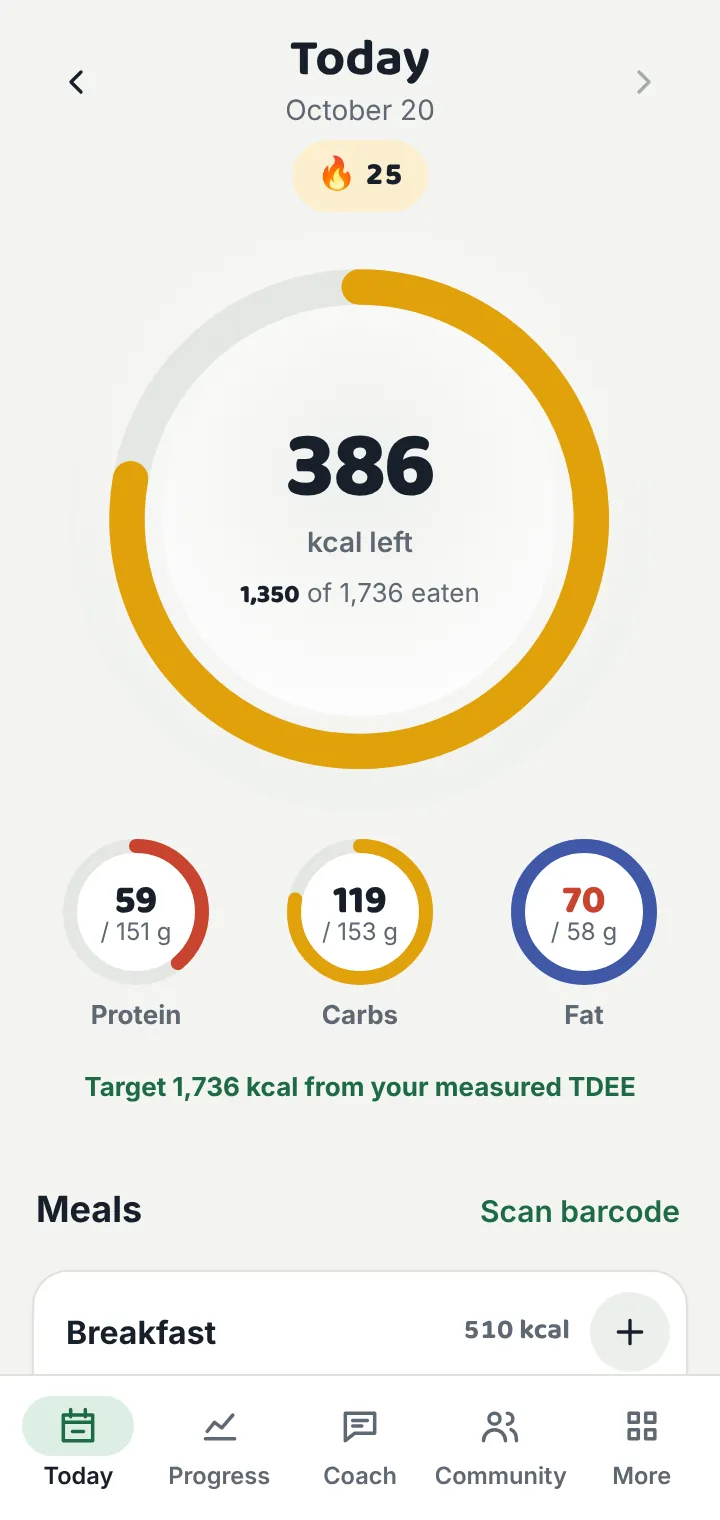
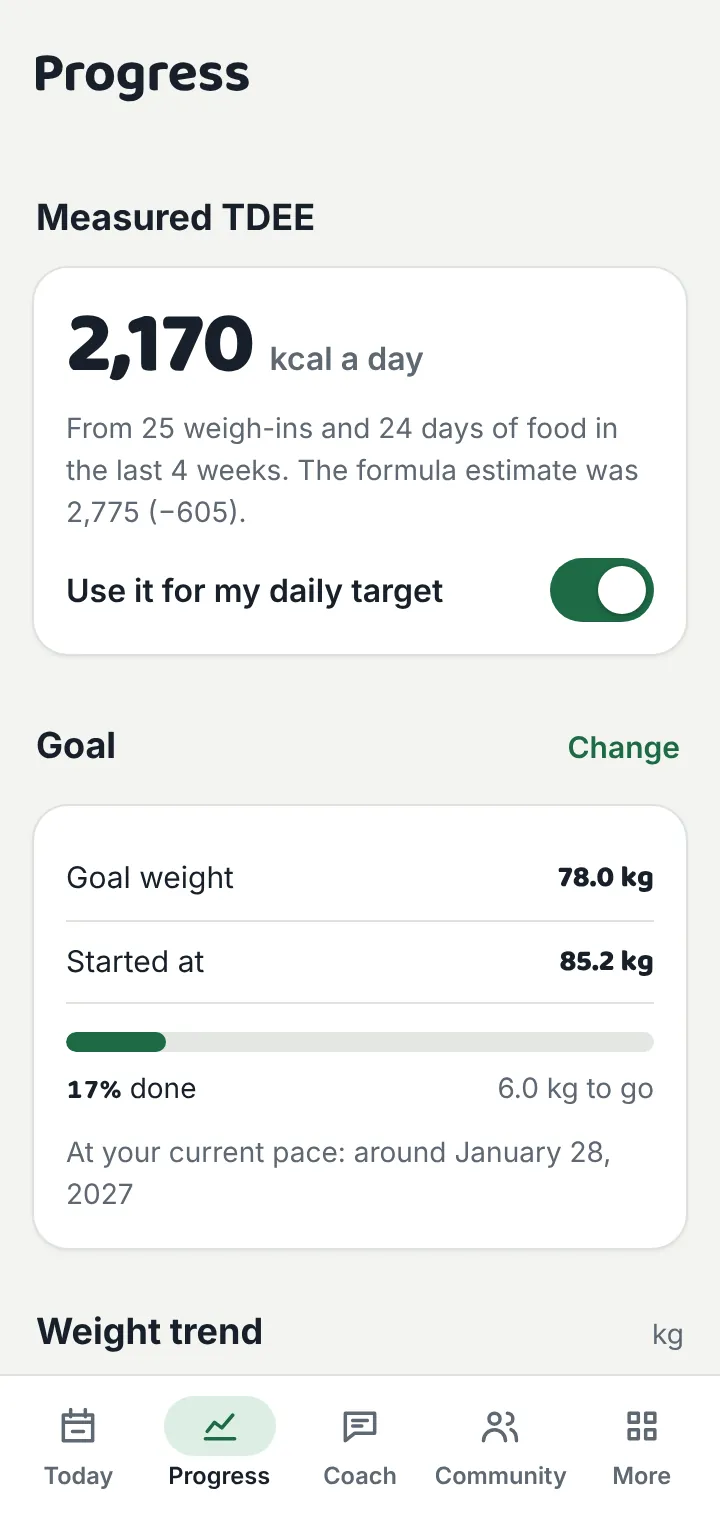
Calculators give an estimate. Log your weight and food for two weeks and the TDEE Calculator app works out what your body really burns, then keeps your target up to date.
- Measured TDEE from your own weight trend and food log
- Food diary with 356 everyday foods from around the world and a barcode scanner
- AI coach and photo calories: snap your plate, check the estimate, add it
- 74 languages, metric or US units, Ramadan mode and reminders
- Private: your log stays on your phone. No ads, no trackers
Lean bulk calculator questions
Is a 200-calorie surplus enough to build muscle?
For most beginners and intermediates, yes. Muscle grows slowly, so a small surplus covers what you can build, and anything much larger mostly adds fat. If your weight and lifts haven’t moved after three or four weeks, add 100 to 150 kcal.
How do I know I’m lean bulking correctly?
Three signs together: your weight is rising at about your target pace, your main lifts are going up, and your waist is steady or rising only slowly. If the scale is rising fast and your waist with it, the surplus is too big.
Can I do cardio while lean bulking?
Yes. Moderate cardio doesn’t stop muscle growth for most people. Just account for the extra calories so your surplus stays a surplus, and keep hard sessions away from heavy leg days.
How long should a lean bulk last?
Because it is slow, a lean bulk often runs for six months or more. Many people stop when they reach a body fat level they don’t want to go above, then spend a few weeks at maintenance or do a short cut.
Should I lean bulk if I’m “skinny fat”?
Often it’s better to start at maintenance with high protein and serious training for a few months. Many people in this position lose some fat and gain muscle at the same time. Once you are leaner and stronger, a lean bulk works well.
Do I need supplements for a lean bulk?
No. Food comes first. Protein powder is a convenient way to reach your target, and creatine monohydrate (about 3 to 5 g a day) is the best-researched supplement for strength and muscle gains. Everything else is optional.
Sources
- Iraki J, Fitschen P, Espinar S, Helms E. Nutrition recommendations for bodybuilders in the off-season: a narrative review. Sports (Basel). 2019;7(7):154. doi.org/10.3390/sports7070154
- Helms E, Valdez A, Morgan A. The Muscle and Strength Pyramid: Nutrition. 2nd ed. 2019.
- Schoenfeld BJ, Ogborn D, Krieger JW. Dose-response relationship between weekly resistance training volume and increases in muscle mass: a systematic review and meta-analysis. J Sports Sci. 2017;35(11):1073-1082. doi.org/10.1080/02640414.2016.1210197
- Schumann M, Feuerbacher JF, Sünkeler M, et al. Compatibility of concurrent aerobic and strength training for skeletal muscle size and function: an updated systematic review and meta-analysis. Sports Med. 2022;52(3):601-612. doi.org/10.1007/s40279-021-01587-7
- Morton RW, Murphy KT, McKellar SR, et al. A systematic review, meta-analysis and meta-regression of the effect of protein supplementation on resistance training-induced gains in muscle mass and strength in healthy adults. Br J Sports Med. 2018;52(6):376-384. doi.org/10.1136/bjsports-2017-097608
- Kreider RB, Kalman DS, Antonio J, et al. International Society of Sports Nutrition position stand: safety and efficacy of creatine supplementation in exercise, training, and rehabilitation. J Int Soc Sports Nutr. 2017;14:18. doi.org/10.1186/s12970-017-0173-z