Bulking Calorie Calculator
Bulking means eating a little more than you burn so your training has the raw material to build muscle. This calculator finds your maintenance, adds a lean, moderate or fast surplus, and shows your protein, carbs and fat and how much weight to expect each week and month.
Key facts
- A surplus of 5 to 15% above maintenance suits most people. For many that is only 150 to 400 kcal a day.
- Muscle grows slowly. Past a certain point, extra calories add fat, not extra muscle.
- Protein of 1.6 to 2.2 g per kg of body weight a day covers most lifters. Carbohydrate fuels the training that makes the bulk work.
- Judge the bulk by your weight trend, waist and strength every two to four weeks, then adjust by 100 to 150 kcal.
On this page
How the calculator works
First it estimates your maintenance calories: your BMR from the Mifflin-St Jeor equation, multiplied by the activity level you choose. Then it adds a surplus of 5, 10 or 15%. Using a percentage means a small lifter and a big lifter both get a surplus that fits their size, instead of everyone being told to add 500 kcal.
Expected weight gain uses the rough rule of 7,700 kcal per kilo (3,500 per pound). Treat that figure as a guide, not a promise. What you gain on a bulk is a mix of muscle, fat, water and stored carbohydrate, and each of those has a different energy cost. Your weigh-ins over the next month are the real answer.
How big a surplus?
The table uses a 75 kg (165 lb) lifter who maintains on 2,600 kcal a day. Your numbers are in the results above.
| Surplus | Extra a day | Gain a week | Suits |
|---|---|---|---|
| Lean, +5% | ≈ 130 kcal | ≈ 0.12 kg | Experienced lifters, people who gain fat easily, anyone who wants to stay lean |
| Moderate, +10% | ≈ 260 kcal | ≈ 0.24 kg | Most people in their first few years of lifting |
| Fast, +15% | ≈ 390 kcal | ≈ 0.35 kg | Beginners who are slim or find it very hard to gain weight |
A 2019 review of off-season nutrition for bodybuilders landed in a similar place. It suggested a surplus of roughly 10 to 20% for novice and intermediate lifters, aiming to gain about 0.25 to 0.5% of body weight a week, and a more cautious surplus and slower gain for advanced lifters. For a 75 kg person, 0.25 to 0.5% a week is roughly 0.2 to 0.4 kg (½ to ¾ lb).
How fast can you build muscle?
Slower than most people hope. Training studies in beginners typically report a kilo or two of extra lean mass over the first two to three months, and progress slows with every year of training after that. Someone with five years of serious lifting behind them may add only a kilo or two of muscle in a whole year.
That is why a bigger surplus doesn’t buy much more muscle. In a small 2019 study of competitive bodybuilders, one group ate about 1,500 kcal a day more than the other for four weeks. The high-calorie group gained a little more muscle, but it was also the only group whose body fat went up significantly. A 2019 review of this question concluded that a surplus probably helps muscle growth, especially in trained people, but that the ideal size isn’t known and large surpluses mainly add fat.
Your surplus should match how fast you can actually build muscle. Beginners can use a bit more. Experienced lifters should use less.
Protein, carbs and fat for a bulk
- Protein: 1.6 to 2.2 g per kg of body weight a day. A 2018 meta-analysis of 49 trials found that the benefit for muscle from extra protein levelled off at about 1.6 g/kg on average. Going higher is safe for healthy people, but it fills you up and leaves less room for the carbs that fuel training.
- Fat: about 0.5 to 1.5 g per kg, which usually means 20 to 35% of calories. Very low fat diets make it hard to get enough fat-soluble vitamins and can affect hormones.
- Carbohydrate: the rest. If you train hard, aim for at least 3 to 5 g per kg. Carbs refill muscle glycogen and help you train with enough volume to grow.
The calculator starts with a balanced split (1.8 g/kg protein, 30% fat, carbs filling the rest). Switch to high-protein, low-carb or keto in the results if you prefer. Calories and protein matter most; the carb and fat split is mostly about what you enjoy and train best on.
Bulking example: a 24-year-old man
A 24-year-old man, 178 cm (5′10″) and 70 kg (154 lb), moderately active, with a year of lifting behind him:
BMR = 10 × 70 + 6.25 × 178 − 5 × 24 + 5 = 1,698 kcal Maintenance = 1,698 × 1.55 = 2,631 kcal Bulk (+10%) = 2,894 kcal a day, a surplus of about 260 kcal Protein = 1.8 × 70 = 126 g · Fat 30% = 96 g · Carbs = 380 g Expected = about 0.24 kg (½ lb) a week, or 1 kg (2 lb) a month
A glass of milk and a banana, or a peanut butter sandwich, adds about 250 to 300 kcal. A bulk doesn’t have to mean forcing down huge meals.
Check and adjust every few weeks
Weigh yourself most mornings and compare two-week averages. Log your main lifts and measure your waist at the navel every two weeks. Then:
| What you see after 3 to 4 weeks | What to do |
|---|---|
| Weight flat or rising very slowly, strength stuck | Add 100 to 150 kcal a day |
| Weight rising at your target pace, lifts going up | Change nothing |
| Weight rising faster than planned, waist growing quickly | Take 100 to 150 kcal a day off |
Expect a jump of 0.5 to 1 kg (1 to 2 lb) in the first week or two as your muscles store more carbohydrate and water. Don’t cut calories because of it. Judge the trend from week three onwards.
Lean bulk or dirty bulk?
A “dirty bulk”, eating whatever and as much as you can, puts weight on fast. Most of the extra is fat, and you’ll have to diet it off later, which costs time and some of the muscle you built. A lean bulk is slower on the scale but means shorter, easier cuts and more time spent actually building.
Food quality still matters on a bulk. Fibre, fruit, vegetables and enough micronutrients support your health and digestion, which matters when you’re eating more every day. Calorie-dense healthy foods such as nuts, nut butters, olive oil, whole milk, oats, rice and dried fruit make a surplus easy without living on takeaways.
Want a surplus set by your training age instead of a percentage? Use the lean bulk calculator.
How long to bulk
Think in months, not weeks. Four to six months is a common block, followed by a short cut or a few weeks at maintenance. Many lifters end a bulk when their waist or body fat has crept up more than they’re happy with, rather than on a fixed date. That limit is a personal choice, not a health rule.
Recalculate your numbers every 4 to 5 kg (10 lb) of gain, because a heavier body needs more food to keep growing.
Log your bulk and see the real trend
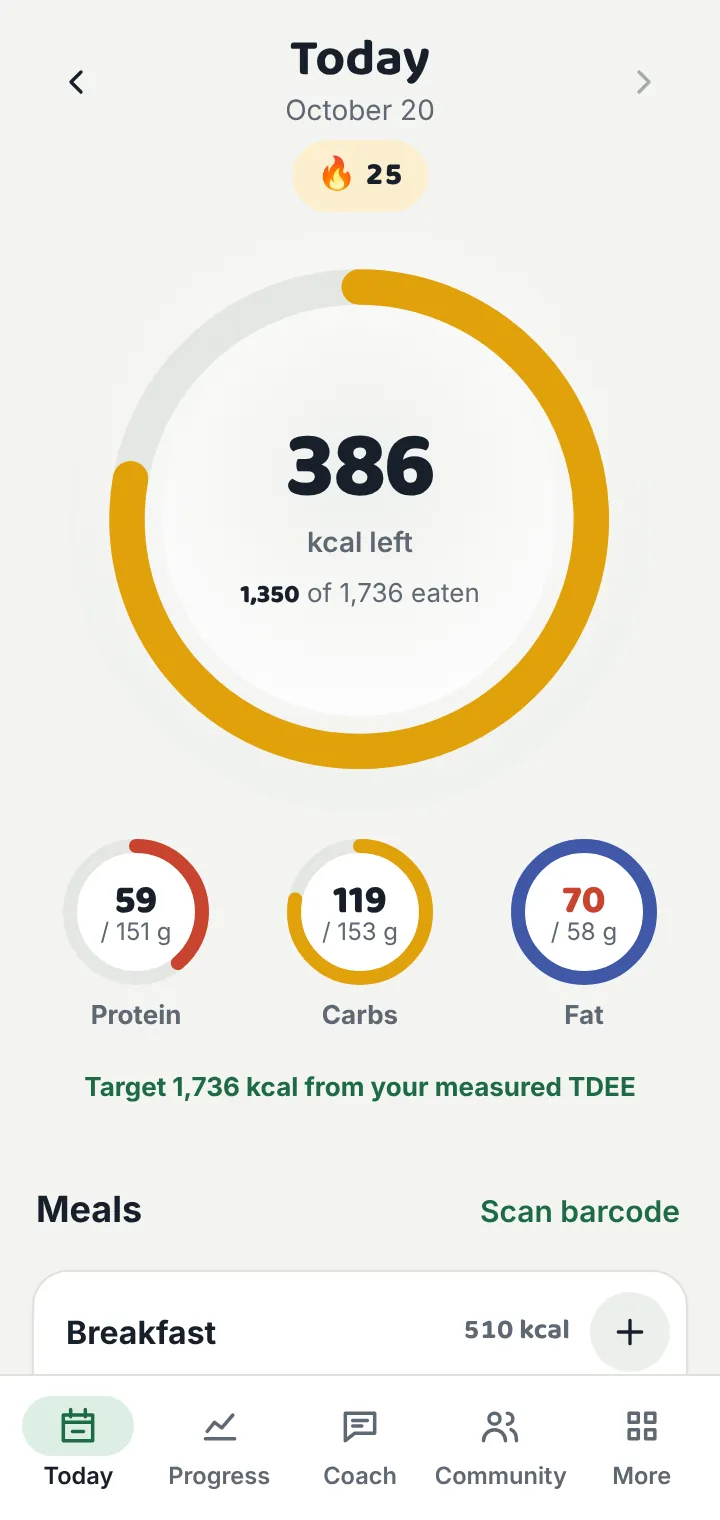
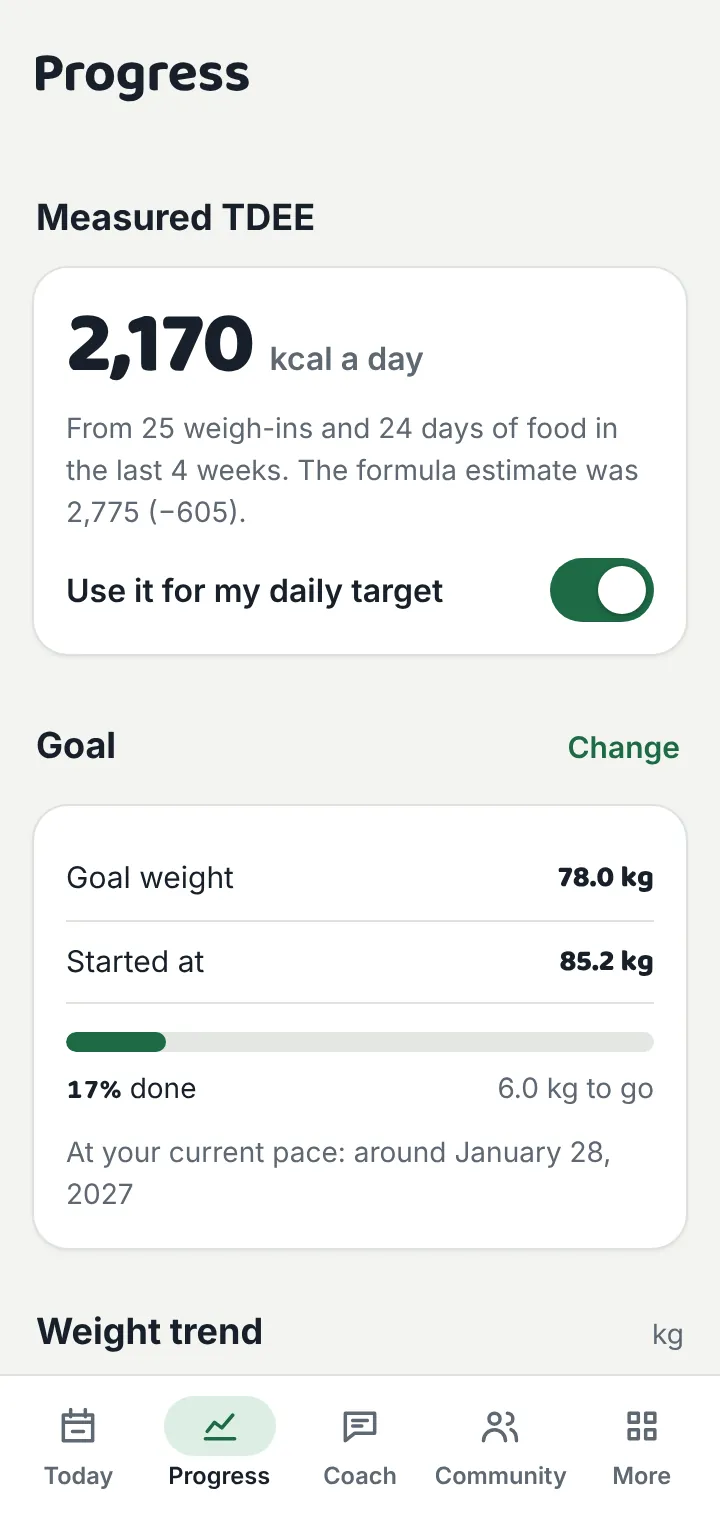
Calculators give an estimate. Log your weight and food for two weeks and the TDEE Calculator app works out what your body really burns, then keeps your target up to date.
- Measured TDEE from your own weight trend and food log
- Food diary with 356 everyday foods from around the world and a barcode scanner
- AI coach and photo calories: snap your plate, check the estimate, add it
- 74 languages, metric or US units, Ramadan mode and reminders
- Private: your log stays on your phone. No ads, no trackers
Bulking calorie calculator questions
How many calories should I eat to bulk?
About 5 to 15% above your maintenance calories. For most people that is 150 to 400 kcal a day more than maintenance. Beginners and slim people can sit at the higher end; experienced lifters should stay near the lower end.
Can I build muscle in a calorie deficit?
Yes, in some cases: beginners, people coming back after a break and people with more body fat can gain muscle while losing fat, as long as protein is high and training is hard. It is slower than in a surplus, and it gets harder the leaner and more experienced you are.
Should I count macros or just calories?
Calories and protein matter most. If you hit your calorie target and get 1.6 to 2.2 g of protein per kg most days, the exact split between carbs and fat is flexible. Counting all three macros can help if you want more control.
How much weight should I gain per week on a bulk?
About 0.25 to 0.5% of your body weight a week is a common target for beginners and intermediates; that is roughly 0.2 to 0.4 kg (½ to ¾ lb) for a 75 kg person. Experienced lifters should aim for less.
Do I need a surplus on rest days?
Keep the same daily target. Muscle repair and growth happen on rest days too, so there is no need to drop to maintenance when you are not training.
What if I can’t eat enough to bulk?
Add calories that don’t fill you up much: milk or smoothies, nut butters, olive oil on food, dried fruit, granola and an extra snack before bed. Spreading food over four or five meals helps too.
Is bulking safe?
For healthy adults, a controlled surplus is safe. This calculator is for people aged 18 and over. If you have a medical condition, such as diabetes or kidney disease, ask your doctor or a registered dietitian before changing your diet.
Sources
- Iraki J, Fitschen P, Espinar S, Helms E. Nutrition recommendations for bodybuilders in the off-season: a narrative review. Sports (Basel). 2019;7(7):154. doi.org/10.3390/sports7070154
- Slater GJ, Dieter BP, Marsh DJ, et al. Is an energy surplus required to maximize skeletal muscle hypertrophy associated with resistance training? Front Nutr. 2019;6:131. doi.org/10.3389/fnut.2019.00131
- Ribeiro AS, Nunes JP, Schoenfeld BJ, Aguiar AF, Cyrino ES. Effects of different dietary energy intake following resistance training on muscle mass and body fat in bodybuilders: a pilot study. J Hum Kinet. 2019;70:125-134. doi.org/10.2478/hukin-2019-0038
- Morton RW, Murphy KT, McKellar SR, et al. A systematic review, meta-analysis and meta-regression of the effect of protein supplementation on resistance training-induced gains in muscle mass and strength in healthy adults. Br J Sports Med. 2018;52(6):376-384. doi.org/10.1136/bjsports-2017-097608
- Mifflin MD, St Jeor ST, Hill LA, et al. A new predictive equation for resting energy expenditure in healthy individuals. Am J Clin Nutr. 1990;51(2):241-247. doi.org/10.1093/ajcn/51.2.241
- Hall KD, Sacks G, Chandramohan D, et al. Quantification of the effect of energy imbalance on bodyweight. Lancet. 2011;378(9793):826-837. doi.org/10.1016/S0140-6736(11)60812-X