Key takeaways
- Your TDEE is a starting estimate; three to four weeks of logging and weigh-ins tell you what you really burn.
- Accuracy matters most for oils, spreads, nuts, cheese, grains and drinks; vegetables can be estimated.
- Being consistent beats being perfect: a log that is 10% off every day still shows you the trend.
- Change your target in small steps of 100 to 150 kcal, and only after two to three weeks of weekly averages.
On this page
- Start with one number
- Choose a way to log
- What to weigh and what to estimate
- Logging day to day
- How accurate do you need to be?
- Weigh yourself the right way
- Read your first four weeks
- When and how to adjust
- What about exercise calories?
- Make it a habit, not a project
- Tracking without counting forever
- When tracking isn’t a good idea
- Calorie tracking questions
Start with one number
A calculator gives you your TDEE, the calories you burn on an average day. Your daily target depends on your goal:
| Goal | Daily target | If your TDEE is 2,400 kcal |
|---|---|---|
| Lose fat | 15 to 25% below TDEE | 1,800 to 2,050 |
| Maintain | Your TDEE | 2,400 |
| Build muscle | 5 to 10% above TDEE | 2,500 to 2,650 |
Round the target to the nearest 50 kcal. Nobody can eat to the exact calorie, and pretending otherwise only makes tracking feel like an exam. If you lift weights or are losing fat, also set a protein target of about 1.6 to 2.2 g per kg of body weight a day. Protein is the one macro worth tracking alongside calories for most people; carbohydrate and fat can fill the rest in whatever balance suits you.
If you haven’t worked out your TDEE yet, start with the TDEE calculator, then come back here.
Choose a way to log
There is no single right method. The best one is the one you will still be using in a month.
| Method | Accuracy | Effort | Best for |
|---|---|---|---|
| App with a food database and barcode scanner | Good, if entries are checked | Medium | Most people, most of the time |
| App plus a kitchen scale | Best | Higher at first | The first few weeks, or when progress stalls |
| Photo log | Rough | Low | Busy days and meals out |
| Hand portions (palm of protein, fist of carbs, thumb of fat) | Rough | Low | After you have learned your portions |
| Paper diary | Depends on you | Medium | People who prefer not to use an app |
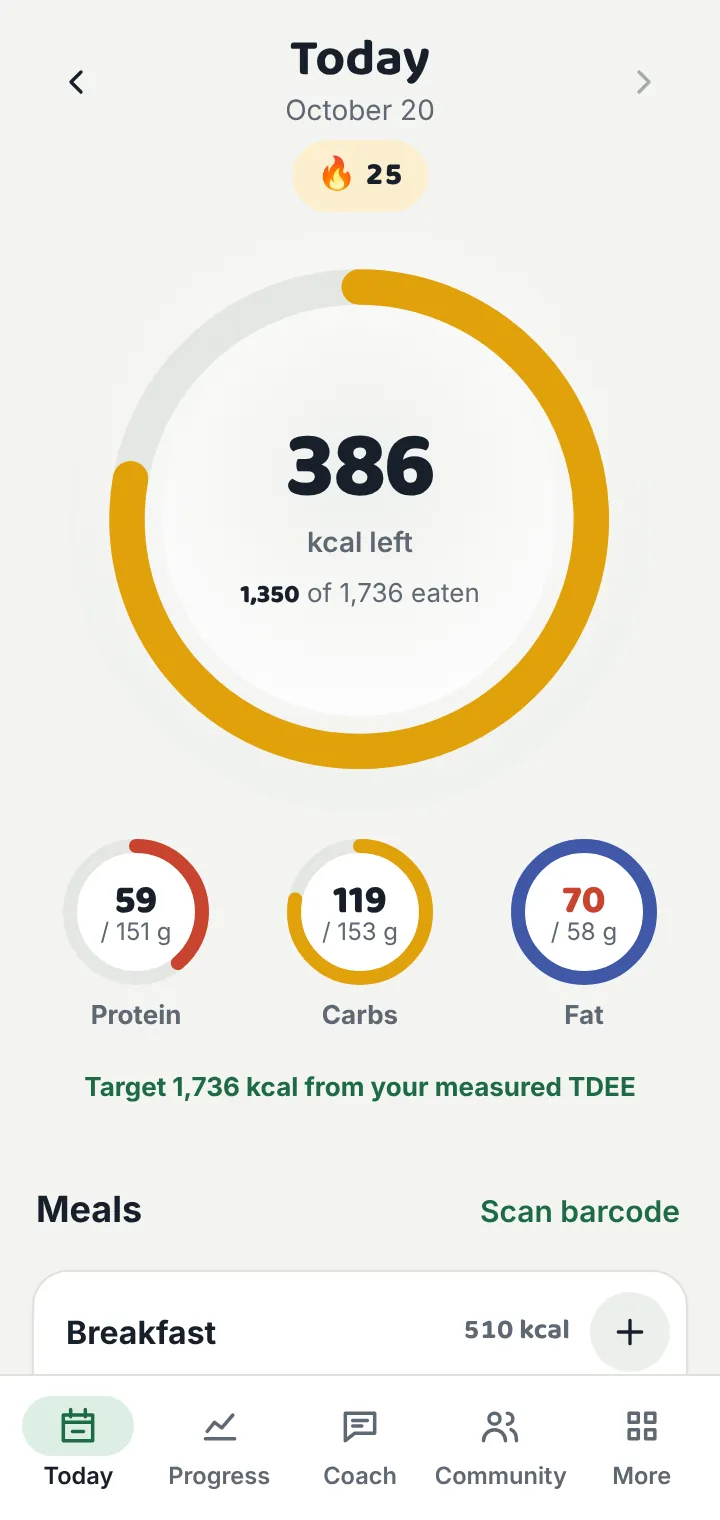
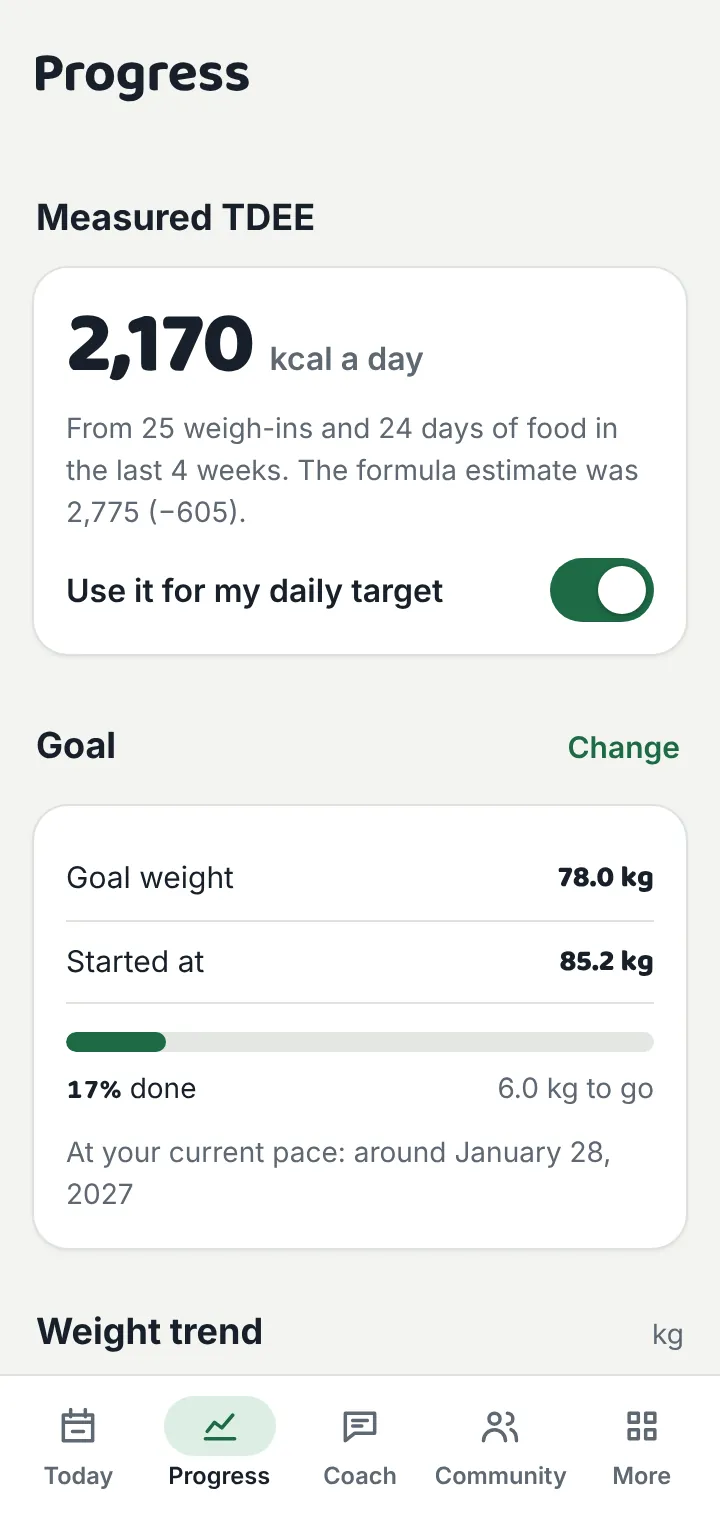
The TDEE Calculator app combines most of these: a food diary, a barcode scanner, a food database with local foods for many countries, quick-add for meals you repeat and an estimate from a photo when you can’t weigh anything. It also turns your log and weigh-ins into a measured TDEE, which is the real point of tracking.
What to weigh and what to estimate
A kitchen scale costs less than a takeaway and is the most useful tool you can buy for this. You don’t need to weigh everything. Focus on the foods where a small mistake means a lot of calories:
- Cooking oil, butter and ghee. One tablespoon of oil is about 120 kcal. A “glug” from the bottle is often two or three tablespoons.
- Nuts, seeds and nut butters. A level tablespoon of peanut butter is about 95 kcal; a heaped one is nearer 200.
- Cheese, cream and chocolate. Small portions, big numbers.
- Rice, pasta, oats, cereal and bread. Portions drift upwards over time without you noticing.
- Drinks. Juice, milky coffee, smoothies, soft drinks and alcohol all count.
Vegetables, salad leaves and most fruit can be estimated. Getting a portion of broccoli wrong by half changes your day by about 15 kcal.
Raw or cooked: pick one and stick to it. Food changes weight as it cooks. Dry pasta and rice roughly double or triple in weight as they absorb water, while meat loses water and gets lighter. 100 g of uncooked rice is about 360 kcal; 100 g of cooked rice is about 130. Weighing food raw is the most consistent, but cooked weights are fine if the entry you choose is also for cooked food. Most big logging errors come from mixing the two.
Logging day to day
- Log as you go, or plan the day in the morning and adjust later. Trying to remember everything at bedtime is how snacks go missing.
- Save meals you repeat. Most people eat the same 15 to 20 meals most weeks. Once they are saved, logging takes seconds.
- Enter home recipes once. Weigh the ingredients and the finished pot, then log your portion by weight.
- Check database entries. User-added entries can be wrong. Prefer barcode scans and entries that match the label.
- Log the small things: milk in tea, a biscuit at work, a taste while cooking, the sauce on the side.
- Log the bad days too. A day you went over is useful data. A missing day makes your whole week look better than it was.
Eating out. Choose the closest match you can find, ideally from the restaurant’s own nutrition information, and log a generous portion. In one US study of reduced-calorie foods, restaurant meals had on average 18% more calories than stated and supermarket frozen meals 8% more. Rounding meals out up by 10 to 20% is a sensible habit.
How accurate do you need to be?
Less than you might think. Labels, databases and your scale all carry some error, so no log is exact. What matters is that your errors are consistent. If you under-record by roughly the same amount every day, your weight trend still tells you the truth, and you adjust your target to fit the trend. A log that is about 10% off but complete is far more useful than a perfect log kept on weekdays only.
The errors that do break tracking are the big, irregular ones: whole meals not logged, weekends “roughly” logged, oil never counted. A well-known study of people who believed they couldn’t lose weight on low calorie intakes found they were eating far more than they recorded and moving less than they reported. They weren’t lying; this is simply how memory works.
Weigh yourself the right way
Your scale weight can swing by 0.5 to 2 kg (1 to 4 lb) from one day to the next because of water, salt, carbohydrate and food in your gut. That is normal and tells you nothing about fat. To see through the noise:
- weigh every morning, after the toilet and before eating or drinking, on the same scale;
- work out the average for each week and compare weeks, not days;
- measure your waist at the navel once a week as a second check;
- if you have periods, compare the same phase of your cycle, or look at four-week trends.
If daily weighing makes you anxious, weigh three or four times a week and still use the average.
Read your first four weeks
Here is a 34-year-old woman with an estimated TDEE of about 2,150 kcal. She sets a target of 1,720 kcal (20% below) and logs an average of exactly that:
| Week | Average weight | What it means |
|---|---|---|
| Start | 82.8 kg (182.5 lb) | Baseline |
| Week 1 | 81.8 kg (180.3 lb) | A fast drop, mostly water and stored carbohydrate. Ignore it. |
| Week 2 | 81.5 kg (179.7 lb) | The real trend starts here |
| Week 3 | 81.0 kg (178.6 lb) | On track |
| Week 4 | 80.7 kg (177.9 lb) | 0.8 kg in two weeks, about 0.4 kg a week |
From week 2 to week 4 she lost 0.8 kg in 14 days. That is 0.8 × 7,700 ÷ 14 = 440 kcal a day coming from her stores, so her measured TDEE is about 1,720 + 440 = 2,160 kcal. Her estimate was almost exactly right, so she changes nothing. If her measured number had come out at 1,900, she would know her real TDEE was lower than the estimate and could adjust with confidence instead of guessing. The adaptive TDEE calculator does this sum for you from your own numbers.
When and how to adjust
Wait at least three weeks before changing anything, and leave out the first week of a new target. Then:
| What you see | What it usually means | What to do |
|---|---|---|
| Losing about as planned | Your target is right | Keep going |
| No loss on a deficit | Logging gaps, or a lower real TDEE | Weigh and log everything for a week; then take off 100 to 150 kcal or add about 2,000 steps a day |
| Losing more than 1% of your weight a week | Deficit bigger than planned | Add 100 to 200 kcal |
| Gaining at maintenance | Real TDEE lower than estimated | Take off 100 to 150 kcal |
| Not gaining on a bulk | Surplus too small | Add 100 to 150 kcal |
| Gaining fast on a bulk, waist growing | Surplus too big | Take off about 100 kcal |
Make one change at a time and give it two to three weeks. If you change your calories, steps and training all at once, you won’t know which one worked.
What about exercise calories?
If your TDEE came from an activity level that includes your usual training, your workouts are already counted. Adding the number from your watch or the treadmill counts them twice, and it is one of the most common reasons people stop losing weight. Only adjust for exercise that is clearly extra, such as a long hike, and even then eat back only part of it. Our guide on eating back exercise calories explains how.
Make it a habit, not a project
In a study of people logging food online during a weight-loss programme, the most successful participants spent about 23 minutes a day logging in the first month and under 15 minutes by the sixth. What predicted success was how often they logged, not how long it took or how detailed it was. Several other studies have found the same thing: people who self-monitor consistently lose more weight than people who don’t.
A few habits keep it quick:
- log at the same moments each day, such as after each meal;
- plan weekends and meals out in advance rather than hoping they won’t count;
- keep a short list of go-to meals and snacks that fit your target;
- don’t chase a perfect day; aim for a consistent week.
Tracking without counting forever
Most people don’t need to log every meal for the rest of their lives. After two or three months you will know roughly what your usual meals contain, and you can step down:
- Log a few days a week instead of every day.
- Use hand portions for meals you know well, and weigh only oils, spreads and snacks.
- Keep weighing yourself most mornings and look at the weekly average.
- Go back to full logging for two weeks if your weekly average drifts by more than about 2 kg (4 to 5 lb), or before starting a new cut or bulk.
When tracking isn’t a good idea
Calorie tracking is a tool, and it doesn’t suit everyone. If logging food makes you anxious, leads to guilt or bingeing, or takes over your thoughts, stop and talk to your doctor. The same applies if you have had an eating disorder. Calorie targets are also not for pregnancy, breastfeeding or anyone under 18 without professional advice. Gentler approaches, such as regular meals, more vegetables and protein, and less alcohol, still work.
Calorie tracking questions
Do I need to hit my calorie target exactly?
No. Being within about 100 kcal on most days is plenty. What matters is your weekly average and how consistently you log.
Should I eat back the calories I burn exercising?
Not if your activity level already includes your training. Eating them back counts the same exercise twice. For unusual extra activity, eat back half at most.
How long should I track before adjusting my calories?
Three to four weeks, leaving out the first week, which is mostly water. Then adjust by 100 to 150 kcal and test again for two to three weeks.
Do I need to weigh my food forever?
No. Weigh carefully for the first few weeks to learn your portions, then weigh only calorie-dense foods, and go back to full weighing if progress stalls.
Why is my weight going up when I eat at my target?
In the first week or two it is usually water: more salt, more carbohydrate, a new training plan or your cycle. If your weekly average keeps rising for three weeks, your real TDEE is lower than the estimate, so take 100 to 150 kcal off.
Are calorie tracking apps accurate?
Roughly. Barcode entries and entries that match the label are good; user-added entries vary. Because you adjust from your weight trend, a small error that repeats every day doesn’t stop tracking from working.
Should I track on weekends?
Yes. Weekend meals are often bigger, and leaving them out makes your log look better than your week really was. It is better to log a rough estimate than nothing.
Is it better to track calories or macros?
Start with calories and protein. Tracking carbohydrate and fat as well rarely changes results for most people, though it can help if you have a performance goal or a diet style you want to follow.
Sources
- Burke LE, Wang J, Sevick MA. Self-monitoring in weight loss: a systematic review of the literature. J Am Diet Assoc. 2011;111(1):92-102. pubmed.ncbi.nlm.nih.gov/21185970/
- Harvey J, Krukowski R, Priest J, West D. Log often, lose more: electronic dietary self-monitoring for weight loss. Obesity (Silver Spring). 2019;27(3):380-384. pubmed.ncbi.nlm.nih.gov/30801989/
- Urban LE, Dallal GE, Robinson LM, et al. The accuracy of stated energy contents of reduced-energy, commercially prepared foods. J Am Diet Assoc. 2010;110(1):116-123. doi.org/10.1016/j.jada.2009.10.003
- Lichtman SW, Pisarska K, Berman ER, et al. Discrepancy between self-reported and actual caloric intake and exercise in obese subjects. N Engl J Med. 1992;327(27):1893-1898. doi.org/10.1056/NEJM199212313272701
- Hall KD, Sacks G, Chandramohan D, et al. Quantification of the effect of energy imbalance on bodyweight. Lancet. 2011;378(9793):826-837. doi.org/10.1016/S0140-6736(11)60812-X
- Morton RW, Murphy KT, McKellar SR, et al. A systematic review, meta-analysis and meta-regression of the effect of protein supplementation on resistance training-induced gains in muscle mass and strength in healthy adults. Br J Sports Med. 2018;52(6):376-384. doi.org/10.1136/bjsports-2017-097608