Steps to Calories Calculator
Turn your daily step count into distance, calories burned walking and an estimate of your total daily burn (TDEE). Your height sets your stride, your weight and pace set the energy cost, and a table shows your TDEE from 4,000 to 15,000 steps.
Key facts
- At a normal pace, 1,000 steps burn roughly 30 to 60 kcal depending on your weight. About 20 to 40 of those are extra compared with sitting still.
- 10,000 steps is about 6.5 to 7.5 km (4 to 4½ miles) for most adults and takes 80 to 100 minutes of walking.
- Walking more is one of the easiest ways to raise your TDEE. In a 2022 analysis of 15 studies, the drop in risk of death levelled off at about 6,000 to 8,000 steps a day for adults over 60 and 8,000 to 10,000 for younger adults.
- Phones and watches count steps fairly well. Their calorie numbers are much less reliable.
On this page
How the calculator works
- Stride length. It estimates your step as about 41.5% of your height for men and 41.3% for women, a long-standing rule of thumb. At 170 cm (5′7″) that is about 70 cm (28 in) a step.
- Distance and time. Steps × stride gives the distance. Dividing by your usual pace (about 4, 5 or 6 km/h) gives the time you spend walking.
- Energy. Walking is given a MET value, a multiple of your resting energy use, from the Compendium of Physical Activities: about 3.0 at an easy 4 km/h (2.5 mph), 3.5 at a normal 5 km/h (3.1 mph) and about 4.5 when brisk at 6 km/h (3.7 mph). One MET is roughly 1 kcal per kg of body weight per hour.
Calories walking = MET × weight (kg) × hours spent walking
For your TDEE it starts from your BMR (Mifflin-St Jeor) × 1.2, the sedentary base, then adds the extra energy of your steps above 2,500 a day and the daily average of any workouts you choose.
Calories per 1,000 and 10,000 steps
For a person 170 cm (5′7″) tall walking at a normal pace:
| Body weight | Per 1,000 steps | Per 10,000 steps | Extra over sitting, 10,000 steps |
|---|---|---|---|
| 60 kg (132 lb) | 30 kcal | 300 kcal | 210 kcal |
| 70 kg (154 lb) | 35 kcal | 345 kcal | 245 kcal |
| 80 kg (176 lb) | 40 kcal | 395 kcal | 280 kcal |
| 90 kg (198 lb) | 44 kcal | 445 kcal | 315 kcal |
| 100 kg (220 lb) | 49 kcal | 495 kcal | 355 kcal |
| 120 kg (265 lb) | 59 kcal | 595 kcal | 425 kcal |
Weight matters most: carrying a heavier body takes more energy. Taller people take longer steps, so they cover more ground and burn a little more per step. Pace matters less than you might expect, because a faster walk burns more per minute but finishes sooner. Per step, a brisk walk burns roughly 15 to 20% more extra energy than a normal one. Hills, stairs and a heavy rucksack add more than speed does.
Gross and net calories
Your watch probably shows gross calories for a walk: everything you burned during it, including the energy you would have used anyway just by being alive. For TDEE maths, the net figure is what counts, the extra energy on top of rest, because your BMR is already part of the total. Add gross calories to your TDEE and you count your resting energy twice.
The calculator shows both. The big number is gross, so it matches what a watch or treadmill tells you. The TDEE only adds the net part.
From steps to your TDEE
A 38-year-old woman, 165 cm (5′5″) and 72 kg (159 lb), walks 7,500 steps a day at a normal pace and doesn’t do other workouts:
BMR = 10 × 72 + 6.25 × 165 − 5 × 38 − 161 = 1,400 kcal Sedentary base (×1.2) = 1,680 kcal Steps above 2,500 = 5,000 steps ≈ 3.4 km → about 123 kcal extra Estimated TDEE ≈ 1,803 kcal a day, like an activity factor of 1.29
At 10,000 steps her estimate would be about 1,864 kcal, and at 15,000 about 1,987.
Why only count steps above 2,500? Even on a day spent mostly sitting, people take a couple of thousand steps around the house and office, and the sedentary factor of 1.2 already covers them.
Treat this as the cautious end of the range. People who walk a lot usually also stand, carry and fidget more, which no step counter captures. If you keep losing weight faster than the numbers predict, your real TDEE is higher than this estimate, and your weigh-ins are the better guide.
What your step count says about your activity level
Researchers Catrine Tudor-Locke and David Bassett proposed simple step bands for healthy adults in 2004, and they are still widely used. Here is how they line up with the activity levels on our calculators:
| Steps a day | Category | Closest activity level here |
|---|---|---|
| Under 5,000 | Sedentary | Sedentary (×1.2) |
| 5,000 to 7,499 | Low active | Sedentary to lightly active |
| 7,500 to 9,999 | Somewhat active | Lightly active (×1.375) |
| 10,000 to 12,499 | Active | Lightly to moderately active |
| 12,500 or more | Highly active | Moderately active (×1.55) or more |
Workouts come on top of this. If you also lift, run or play sport on most days, move up a level. The activity level calculator combines your steps, your job and your workouts into one answer.
How accurate are step counts?
Counting steps is the thing devices do best. In a 2015 treadmill test, smartphone apps counted within about 7% of the true number of steps, while some wrist and hip wearables undercounted by up to about 23%. Counts get worse at very slow speeds, when you push a pram or trolley, or when the phone sits in a bag.
Calorie estimates are much shakier. In a 2017 Stanford study, 60 people wore seven popular wrist devices. Even the best device’s energy estimates had a median error of about 27%, and the worst about 93%. So use your step count as the input and let a transparent formula, like the one here, do the calorie maths.
Easy ways to add steps
- Walk after meals. Ten minutes after each main meal adds roughly 3,000 to 3,500 steps a day, and light walking after eating also blunts the rise in blood sugar.
- Walk while you talk. Take phone calls on your feet.
- Make the journey longer. Get off one stop early, park at the far end, use the stairs.
- Raise your target slowly. Add about 1,000 steps a day each week until you reach a level you can keep.
- Count the steps you have, not the ones you planned. Check your weekly average and enter that in the calculator.
Count your walks and runs with GPS in the app
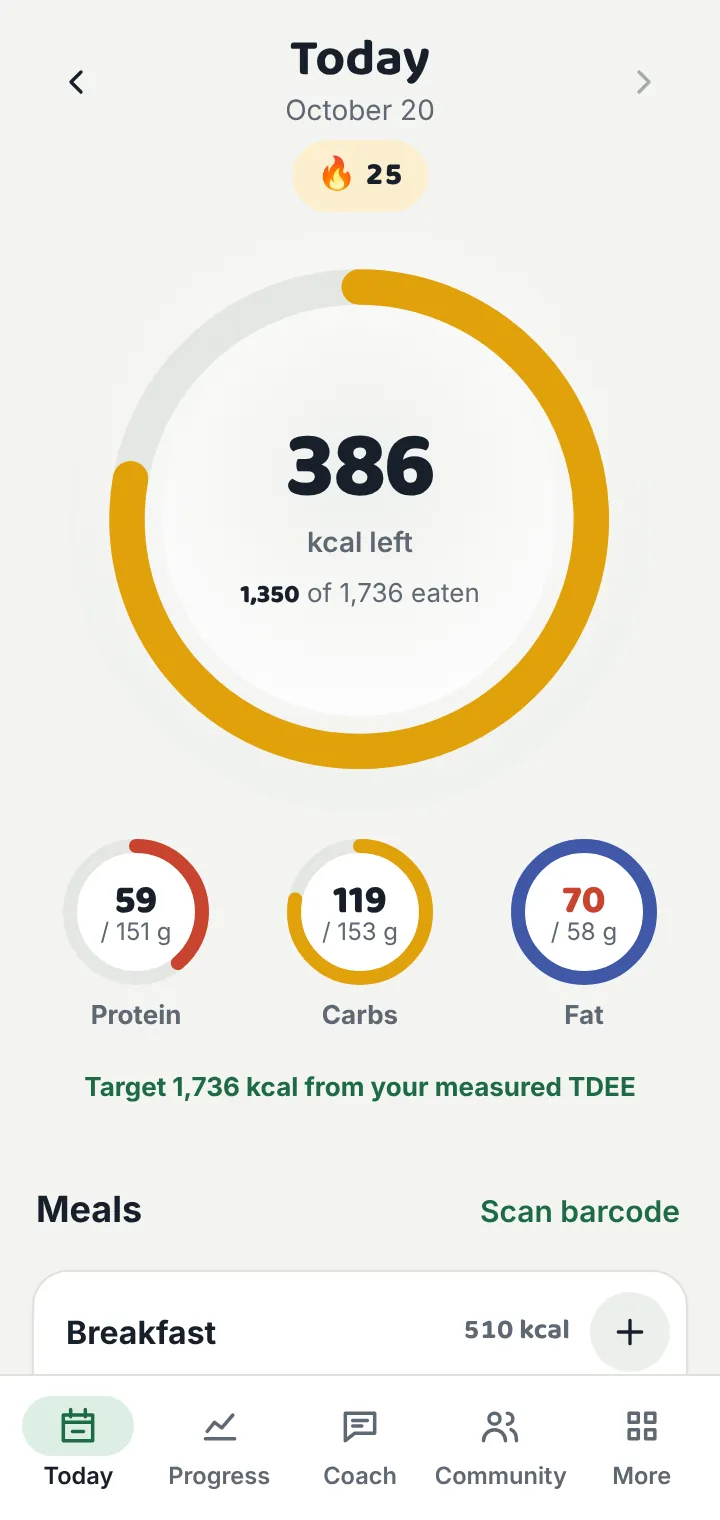
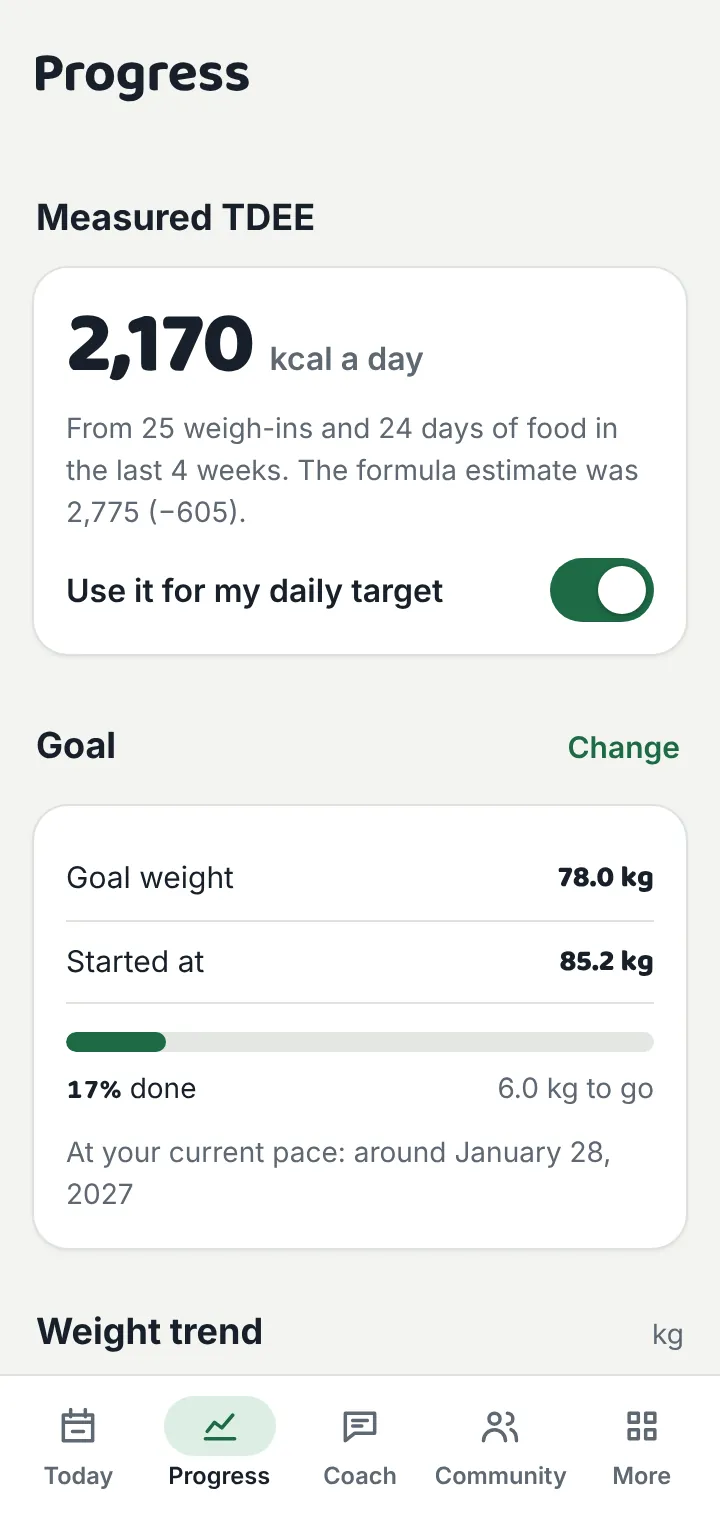
Calculators give an estimate. Log your weight and food for two weeks and the TDEE Calculator app works out what your body really burns, then keeps your target up to date.
- Measured TDEE from your own weight trend and food log
- Food diary with 356 everyday foods from around the world and a barcode scanner
- AI coach and photo calories: snap your plate, check the estimate, add it
- 74 languages, metric or US units, Ramadan mode and reminders
- Private: your log stays on your phone. No ads, no trackers
Steps to calories calculator questions
How many calories does 10,000 steps burn?
For most adults, about 300 to 500 kcal in total at a normal pace, of which roughly 200 to 350 kcal is extra compared with sitting still. Heavier and taller people burn more; lighter and shorter people burn less.
How far is 10,000 steps?
About 6.5 to 7.5 km (4 to 4½ miles) for most adults. Taller people with a longer stride cover more ground.
Should I add my step calories to my TDEE?
Not if you already chose an activity level that includes your usual walking. Either use this calculator’s TDEE, which adds the steps for you, or pick a level, but don’t do both.
Do steps count as exercise for my activity level?
Yes. A lot of daily walking can move you up a level even without workouts. Under about 5,000 steps a day is sedentary; around 7,500 to 10,000 is usually lightly active.
Is walking or running better for burning calories?
Running burns more per minute and a bit more per kilometre. Walking is easier to do every day and to recover from, so many people end up burning more in a week by walking. For fat loss, the one you keep doing is the better choice.
How many steps a day should I aim for?
More than you do now is a good start. For health, research suggests most of the benefit comes by about 6,000 to 8,000 steps a day for adults over 60 and 8,000 to 10,000 for younger adults. For weight loss, steps simply add to your daily burn.
Sources
- Tudor-Locke C, Bassett DR Jr. How many steps/day are enough? Preliminary pedometer indices for public health. Sports Med. 2004;34(1):1-8. doi.org/10.2165/00007256-200434010-00001
- Ainsworth BE, Haskell WL, Herrmann SD, et al. 2011 Compendium of Physical Activities: a second update of codes and MET values. Med Sci Sports Exerc. 2011;43(8):1575-1581. doi.org/10.1249/MSS.0b013e31821ece12
- Herrmann SD, Willis EA, Ainsworth BE, et al. 2024 Adult Compendium of Physical Activities: a third update of the energy costs of human activities. J Sport Health Sci. 2024;13(1):6-12. doi.org/10.1016/j.jshs.2023.10.010
- Paluch AE, Bajpai S, Bassett DR, et al. Daily steps and all-cause mortality: a meta-analysis of 15 international cohorts. Lancet Public Health. 2022;7(3):e219-e228. doi.org/10.1016/S2468-2667(21)00302-9
- Case MA, Burwick HA, Volpp KG, Patel MS. Accuracy of smartphone applications and wearable devices for tracking physical activity data. JAMA. 2015;313(6):625-626. doi.org/10.1001/jama.2014.17841
- Shcherbina A, Mattsson CM, Waggott D, et al. Accuracy in wrist-worn, sensor-based measurements of heart rate and energy expenditure in a diverse cohort. J Pers Med. 2017;7(2):3. doi.org/10.3390/jpm7020003
- Buffey AJ, Herring MP, Langley CK, Donnelly AE, Carson BP. The acute effects of interrupting prolonged sitting time in adults with standing and light-intensity walking on biomarkers of cardiometabolic health in adults: a systematic review and meta-analysis. Sports Med. 2022;52(8):1765-1787. doi.org/10.1007/s40279-022-01649-4