Body Fat TDEE Calculator
If you know your body fat percentage, you can estimate your daily burn from your lean body mass instead of your total weight. This calculator puts Katch-McArdle and Cunningham, which use lean mass, next to Mifflin-St Jeor and Harris-Benedict, which use weight, so you can see which fits you.
Key facts
- Lean body mass, everything except fat, explains most of the difference in resting metabolism between people.
- Katch-McArdle: BMR = 370 + 21.6 × lean mass (kg). Cunningham: BMR = 500 + 22 × lean mass (kg).
- Lean-mass formulas help most for very lean, muscular people, whom weight-based formulas tend to underestimate.
- A 3-point error in your body fat reading moves the answer by only about 50 to 100 kcal a day, so a reasonable estimate is good enough.
On this page
Why lean mass matters
Not every kilo of you burns the same. At rest, a kilo of skeletal muscle uses about 13 kcal a day and a kilo of fat tissue about 4.5. Organs are far hungrier: the liver and brain use roughly 200 to 240 kcal per kilo per day, and the heart and kidneys about 440. Together, these “lean” tissues do almost all the work of your resting metabolism.
So two people who weigh the same can burn quite different amounts if one carries a lot more muscle. Weight-based equations such as Mifflin-St Jeor can’t see that. They assume your body is built like the average person in the study they came from. Lean-mass equations skip that assumption by working from the part of you that actually burns the energy.
Lean body mass = weight × (1 − body fat % ÷ 100) Example: 80 kg at 20% body fat → 80 × 0.80 = 64 kg lean mass
The two lean-mass formulas
Katch-McArdle: BMR = 370 + 21.6 × lean mass (kg) Cunningham: BMR = 500 + 22 × lean mass (kg)
Katch-McArdle comes from the exercise physiology textbook by William McArdle, Frank Katch and Victor Katch. It is the lean-mass formula most calculators use.
Cunningham (1980) came from a reanalysis of the classic Harris-Benedict measurements, which found that lean body mass was the best single predictor of basal metabolic rate. It usually gives a result 100 to 200 kcal higher than Katch-McArdle. A 2014 study of recreational athletes found that the Cunningham equation predicted their resting energy well, which is why it is often suggested for active, muscular people.
Neither formula uses age or sex. That isn’t an oversight: most of the effect of age and sex on metabolism works through how much lean mass you have, and that is already in the number.
Who benefits most
- Lean, muscular people. If you lift seriously and carry little fat, roughly men under 15% and women under 23% body fat, weight-based formulas often come out low. Lean-mass formulas usually fit better.
- People who know their body fat from a decent method. A DEXA scan, a trained tester with calipers or a carefully done tape measurement makes these formulas worth using.
- People with higher body fat. Here the lean-mass result is a useful cross-check rather than an automatic upgrade. Mifflin-St Jeor was developed in a group that included people with obesity and holds up well, while lean-mass formulas give no credit for the small amount of energy fat tissue does use.
If you don’t know your body fat, you’re not missing much. Mifflin-St Jeor on the TDEE calculator is the best starting point for most adults.
Same weight, different bodies
Two 30-year-old men, both 180 cm (5′11″) and 80 kg (176 lb), both moderately active (×1.55). One has 12% body fat, the other 30%.
| TDEE by formula | 12% body fat 70.4 kg lean | 30% body fat 56 kg lean |
|---|---|---|
| Katch-McArdle | 2,930 kcal | 2,448 kcal |
| Cunningham | 3,176 kcal | 2,685 kcal |
| Mifflin-St Jeor | 2,759 kcal | 2,759 kcal |
Mifflin-St Jeor gives them exactly the same number, because it only sees height, weight, age and sex. Katch-McArdle puts them almost 500 kcal a day apart. For the lean man, a weight-based estimate could leave him eating less than he needs; for the man with more fat, it could leave him eating more. That gap is the whole reason to use lean mass.
How to measure your body fat
| Method | Typical error | Good to know |
|---|---|---|
| DEXA scan | About 1 to 2 points | The best widely available option. Results differ a little between machines, so use the same clinic. |
| Underwater weighing or BodPod | About 2 to 3 points | Accurate, but hard to find outside universities and some gyms. |
| Skinfold calipers | About 3 to 4 points | Good in trained hands. The same tester each time matters more than the formula. |
| Tape measure (U.S. Navy method) | About 3 to 4 points | Free and repeatable. Try our body fat calculator. |
| Smart scale (bioimpedance) | About 3 to 5 points or more | Shifts with hydration, meals and exercise. Best for trends measured under the same conditions. |
Whatever you use, measure in the same conditions every time: first thing in the morning, after the toilet, before food, drink or exercise.
How much does a wrong reading matter?
Less than you might fear. Each percentage point of body fat changes your lean mass by 1% of your weight. For an 80 kg person, a 3-point error is 2.4 kg of lean mass. That moves Katch-McArdle BMR by about 52 kcal and TDEE by about 80 kcal at a moderate activity level. Picking the wrong activity level can easily cost five times as much. The results above show this range for your own numbers.
Which number should you use?
- The formulas agree within about 100 kcal: it doesn’t matter. Pick one and test it.
- You’re lean and muscular and the lean-mass result is higher: start with Katch-McArdle, or halfway between it and Mifflin-St Jeor.
- Your body fat came from a bathroom scale and the results disagree a lot: start with Mifflin-St Jeor.
In every case, eat at your chosen number for two to four weeks and watch your weekly average weight. Your scale settles the argument better than any equation. The formula comparison guide explains how the equations were built and where each one tends to go wrong.
Your real TDEE, measured by the app
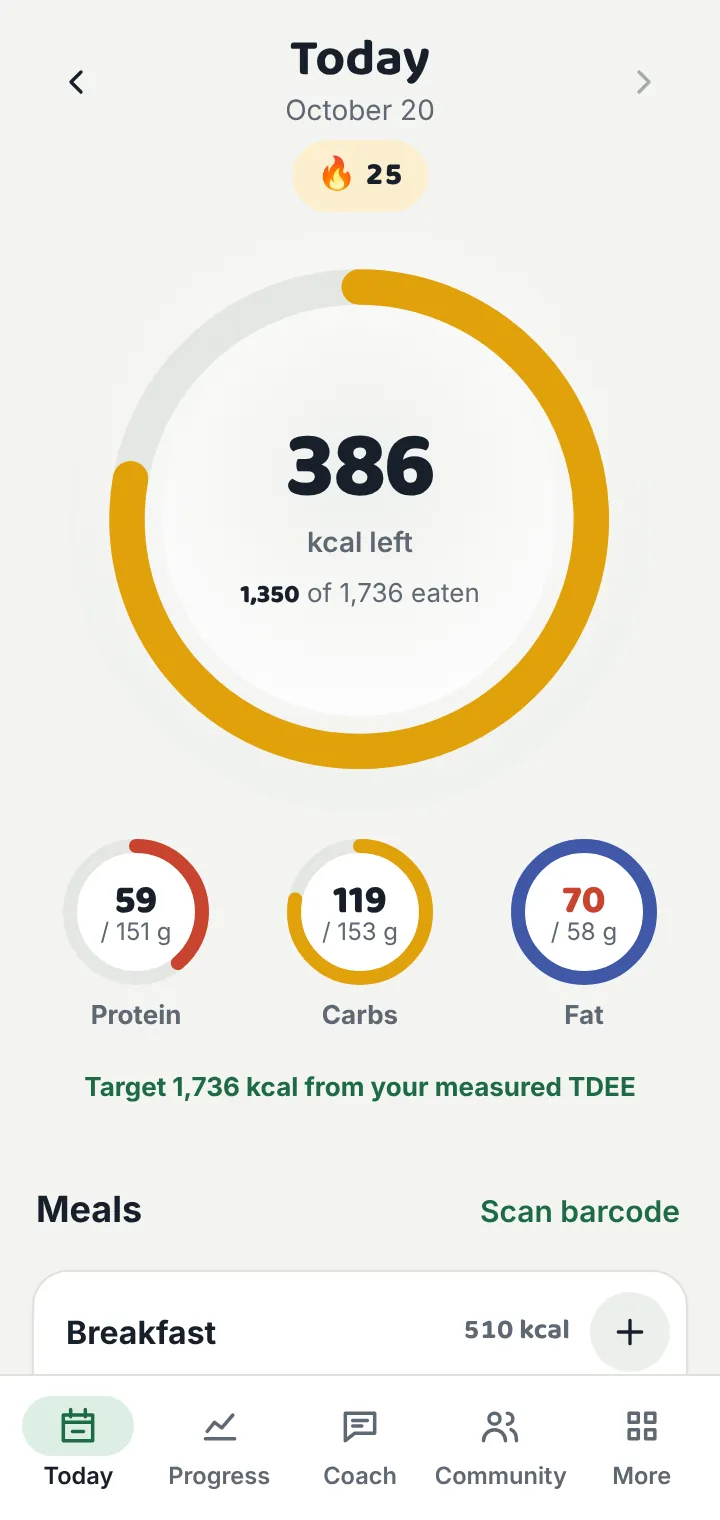
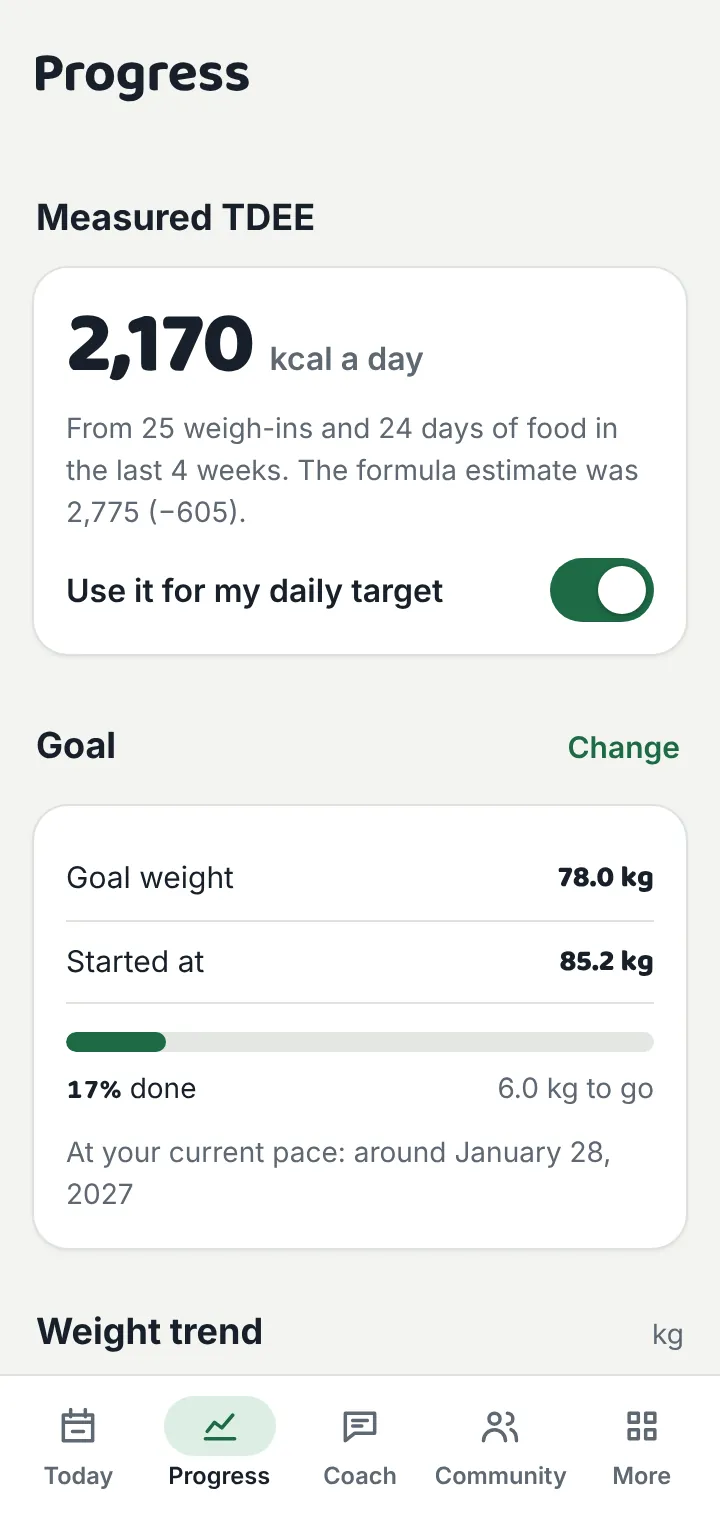
Calculators give an estimate. Log your weight and food for two weeks and the TDEE Calculator app works out what your body really burns, then keeps your target up to date.
- Measured TDEE from your own weight trend and food log
- Food diary with 356 everyday foods from around the world and a barcode scanner
- AI coach and photo calories: snap your plate, check the estimate, add it
- 74 languages, metric or US units, Ramadan mode and reminders
- Private: your log stays on your phone. No ads, no trackers
Body fat TDEE calculator questions
Is Katch-McArdle more accurate than Mifflin-St Jeor?
For lean, muscular people with a good body fat measurement, it often is. For most other adults there is no clear advantage, and Mifflin-St Jeor is the safer default because it doesn’t depend on a body fat reading.
What if I don’t know my body fat percentage?
You can estimate it with a tape measure in our body fat calculator, or simply use the TDEE calculator with Mifflin-St Jeor, which needs only your height, weight, age and sex.
What is the difference between Katch-McArdle and Cunningham?
Both work from lean body mass, but Cunningham uses a larger constant and a slightly larger multiplier, so it usually comes out 100 to 200 kcal higher. Cunningham is often preferred for athletes and very active people.
Why don’t these formulas use age or sex?
Because most of the effect of age and sex on resting metabolism comes through lean mass. Men tend to have more of it, and many people lose some with age. Once lean mass is in the equation, age and sex add little.
How often should I measure my body fat?
Every four to eight weeks is plenty. Body fat changes slowly, and measuring more often mostly shows measurement noise. Use the same method under the same conditions each time.
Can I use this calculator if I have a lot of weight to lose?
Yes, but treat the lean-mass result as a second opinion. At higher body fat, Mifflin-St Jeor holds up well, and the real test is the same for everyone: two to four weeks of weigh-ins at your chosen intake.
Sources
- Cunningham JJ. A reanalysis of the factors influencing basal metabolic rate in normal adults. Am J Clin Nutr. 1980;33(11):2372-2374. doi.org/10.1093/ajcn/33.11.2372
- McArdle WD, Katch FI, Katch VL. Exercise Physiology: Nutrition, Energy, and Human Performance. Wolters Kluwer.
- ten Haaf T, Weijs PJM. Resting energy expenditure prediction in recreational athletes of 18-35 years: confirmation of Cunningham equation and an improved weight-based alternative. PLoS One. 2014;9(10):e108460. doi.org/10.1371/journal.pone.0108460
- Elia M. Organ and tissue contribution to metabolic rate. In: Kinney JM, Tucker HN, eds. Energy Metabolism: Tissue Determinants and Cellular Corollaries. Raven Press; 1992:61 to 79.
- Mifflin MD, St Jeor ST, Hill LA, et al. A new predictive equation for resting energy expenditure in healthy individuals. Am J Clin Nutr. 1990;51(2):241-247. doi.org/10.1093/ajcn/51.2.241
- Frankenfield D, Roth-Yousey L, Compher C. Comparison of predictive equations for resting metabolic rate in healthy nonobese and obese adults: a systematic review. J Am Diet Assoc. 2005;105(5):775-789. pubmed.ncbi.nlm.nih.gov/15883556/
- Heyward VH, Wagner DR. Applied Body Composition Assessment. 2nd ed. Human Kinetics; 2004.